
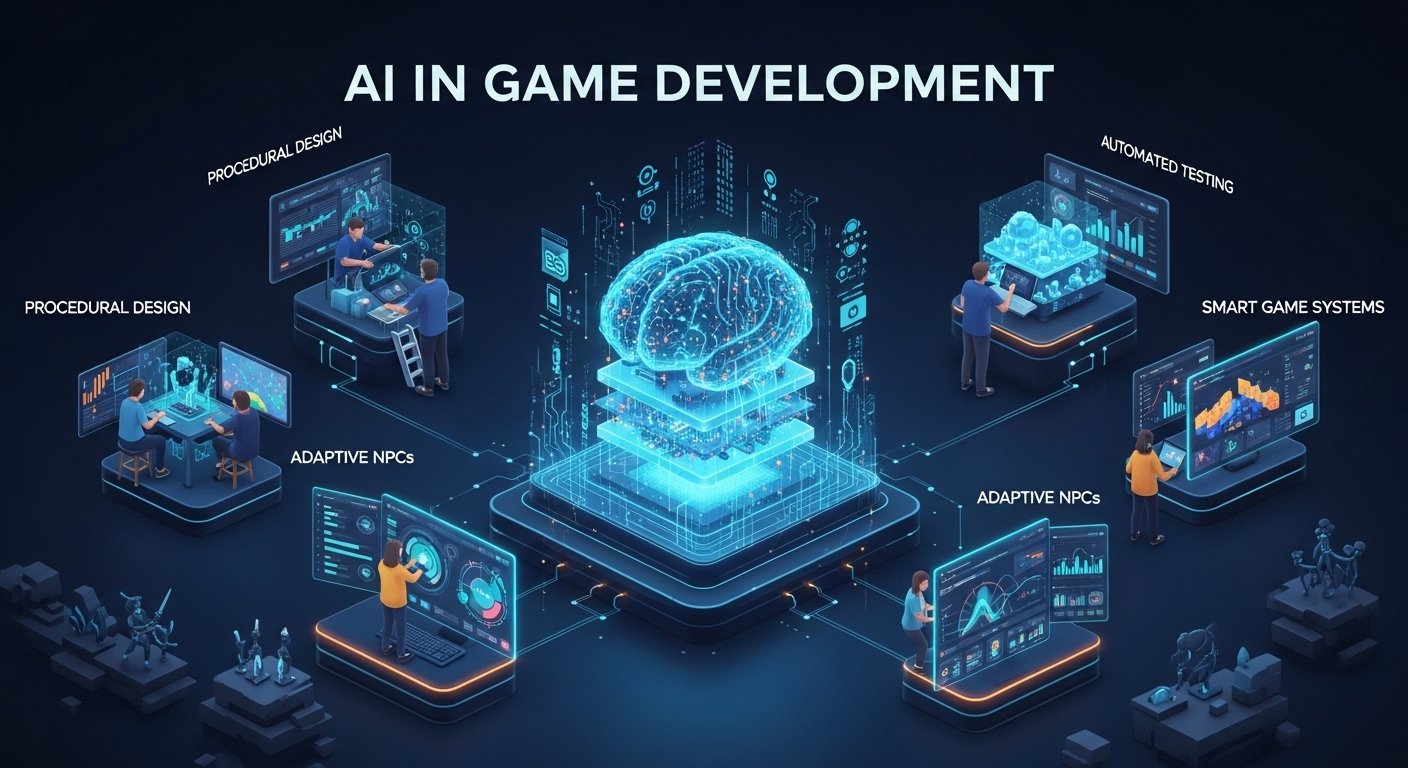
When I first started working in game development back in 2015, creating believable enemy behavior meant writing hundreds of lines of if-else statements. It was tedious, prone to bugs, and honestly, the results were often predictable. Players would learn the patterns within hours. Fast forward to today, and the landscape looks completely different.
Artificial intelligence has fundamentally changed how we build games. Not just in the obvious ways you might expect, but in subtle, surprising areas that most players never even notice.
The Evolution of Smart NPCs
Remember playing older games where enemies would run straight at you, following the same path every single time? Those days are fading fast. Modern AI systems allow non playable characters to adapt, learn, and respond to player behavior in ways that feel genuinely organic.
Take a game like The Last of Us Part II. The enemy AI doesn’t just follow scripted routes. They communicate with each other, call out your position, and adjust their tactics based on how you’ve been playing. If you’ve been using stealth, they become more vigilant. Start going in guns blazing, and they’ll take cover more aggressively.
This kind of dynamic behavior comes from decision making systems like behavior trees and utility AI, which allow developers to create complex, layered responses without manually programming every possible scenario.
Procedural Content Generation: Building Worlds That Build Themselves
Here’s where things get really interesting from a development standpoint. Creating game content levels, textures, music, dialogue traditionally requires enormous teams working for years. AI-driven procedural generation is changing that equation entirely.
No Man’s Sky remains the poster child for this approach. The game features over 18 quintillion planets, each with unique ecosystems, creatures, and landscapes. Obviously, no human team could hand-craft that much content. Instead, the developers at Hello Games built sophisticated algorithms that generate these worlds on the fly.
But procedural generation isn’t just about scale. It’s about replayability and surprise. Games like Spelunky and Dead Cells use procedural level design to ensure each playthrough feels fresh. Players can’t memorize layouts or optimal routes because they change every time.
I’ve worked on smaller projects using similar techniques, and honestly, watching an algorithm generate a playable level that I didn’t design never stops feeling a bit magical.
AI as a Development Tool
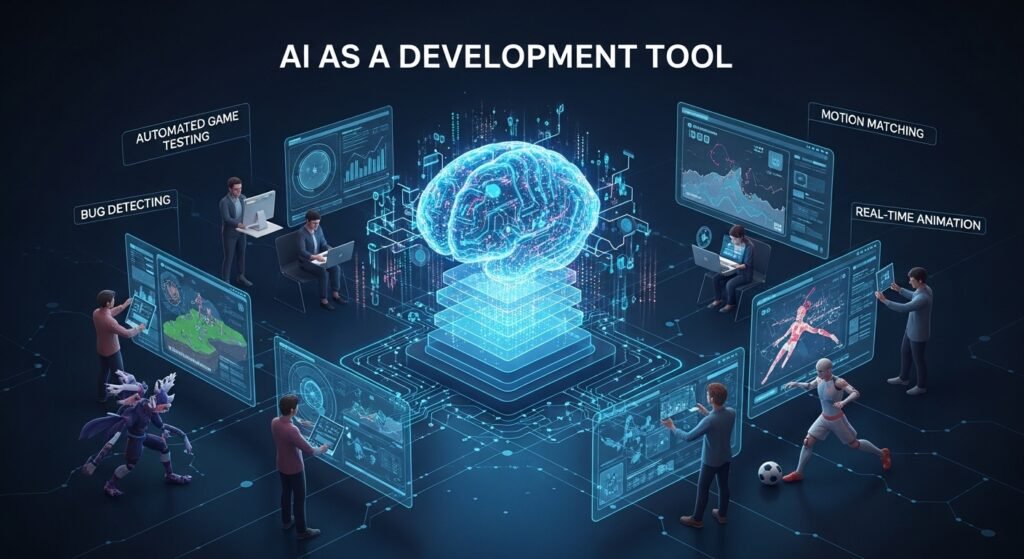
Beyond what players experience, AI is transforming the development process itself. Quality assurance testing used to mean hiring dozens of testers to play through every possible scenario, looking for bugs, exploits, and balance issues. Now, machine learning agents can do much of this work.
Electronic Arts developed an AI system called the “automated game testing” framework that can complete thousands of game sessions overnight, identifying crashes, progression blockers, and other issues far faster than human testers could manage.
That doesn’t mean human QA is obsolete far from it. Human testers catch the kind of nuanced, “this feels wrong” issues that automated systems miss. But combining both approaches means games ship with fewer problems.
Animation is another area seeing rapid transformation. Motion matching systems, like those used in FIFA and For Honor, blend captured animation data in real-time based on context. The result is movement that looks more natural and responsive than traditional animation blending could achieve.
The Creative Collaboration Question
Here’s where I’ll admit things get complicated. There’s ongoing debate in the industry about how far AI should go in the creative process. When algorithms start generating dialogue, music, or even narrative elements, questions arise about authorship and artistic vision.
I’ve spoken with colleagues who are genuinely excited about AI as a creative partner. They see it as a tool that handles grunt work, freeing them to focus on higher-level creative decisions. Others worry about job displacement or the homogenization of game experiences.
The truth probably lies somewhere in between. AI excels at iterating quickly, generating options, and handling repetitive tasks. What it struggles with at least currently is understanding emotional resonance, cultural context, and the kind of intentional artistic choices that make games memorable.
The most successful implementations I’ve seen treat AI as a collaborator rather than a replacement. Developers use generated content as a starting point, then refine and curate the results to fit their vision.
Current Limitations and Challenges
Let’s be honest about what AI can’t do yet. Training sophisticated models requires substantial computing resources and expertise that smaller studios often lack. There’s also the unpredictability factor—AI systems can produce results that are technically functional but tonally wrong or culturally insensitive.
I’ve seen procedural systems generate level layouts that were technically completable but absolutely miserable to play. The algorithm checked all the right boxes without understanding that games need to feel good, not just function correctly.
Data requirements present another hurdle. Machine learning models need vast amounts of training data, which isn’t always available or ethical to collect. Privacy concerns around player behavior data are becoming increasingly relevant as AI systems grow more sophisticated.
What’s Coming Next
The trajectory seems clear. AI will become more integrated into every aspect of development, from initial concepting through post-launch support. Real-time ray tracing combined with AI upscaling is already delivering visuals that would have been impossible a few years ago.
Personalized gaming experiences where the game adapts not just difficulty but narrative elements, pacing, and content to individual players are on the horizon. Imagine a horror game that learns what genuinely unsettles you and adjusts accordingly.
Whether that sounds exciting or unsettling probably says something about your relationship with technology generally.
Final Thoughts
AI in game development isn’t some distant future concept. It’s here, it’s evolving rapidly, and it’s touching virtually every aspect of how games get made and played. The developers who learn to work alongside these tools effectively will have significant advantages. Those who dismiss them entirely risk falling behind.
What matters most is maintaining the human element the creative spark, the emotional intelligence, the cultural awareness that makes games resonate with players on a deeper level. AI is a powerful amplifier, but it still needs human judgment to wield effectively.
Frequently Asked Questions
Will AI replace game developers?
Not likely. AI handles specific tasks more efficiently, but creative direction, narrative design, and artistic vision still require human expertise.
Which games use AI most effectively?
The Last of Us Part II, F.E.A.R., Alien: Isolation, and No Man’s Sky are commonly cited examples of innovative AI implementation.
Can indie developers use AI tools?
Absolutely. Tools like Unity ML Agents and various procedural generation systems are accessible to smaller teams with limited budgets.
Does AI make games easier or harder?
It enables smarter difficulty scaling, adapting challenge levels to individual player skill rather than static difficulty settings.
What skills should aspiring developers learn?
Understanding machine learning basics, behavior trees, and procedural generation concepts will become increasingly valuable alongside traditional development skills.