
The moment I truly appreciated dynamic NPC reactions wasn’t during some epic quest. It was watching a shopkeeper in Red Dead Redemption 2 nervously eye the mud I’d tracked across his floor, then mutter something disparaging about cowboys with no manners. Nobody scripted that moment for me specifically. The game’s systems noticed the dirt, processed the context, and generated an organic response.
That small interaction demonstrated something profound about modern game design. Non player characters aren’t just quest dispensers anymore. They’re becoming inhabitants of living worlds that genuinely react to player presence and behavior.
Beyond the Static Shopkeeper
For decades, NPCs existed as furniture with dialogue options. They stood in predetermined spots, repeated identical lines, and remained oblivious to everything happening around them. You could literally save a village from dragon attack, then walk past the same villager who’d ask if you’d considered joining the fighter’s guild. The disconnect was jarring but accepted as technical limitation.
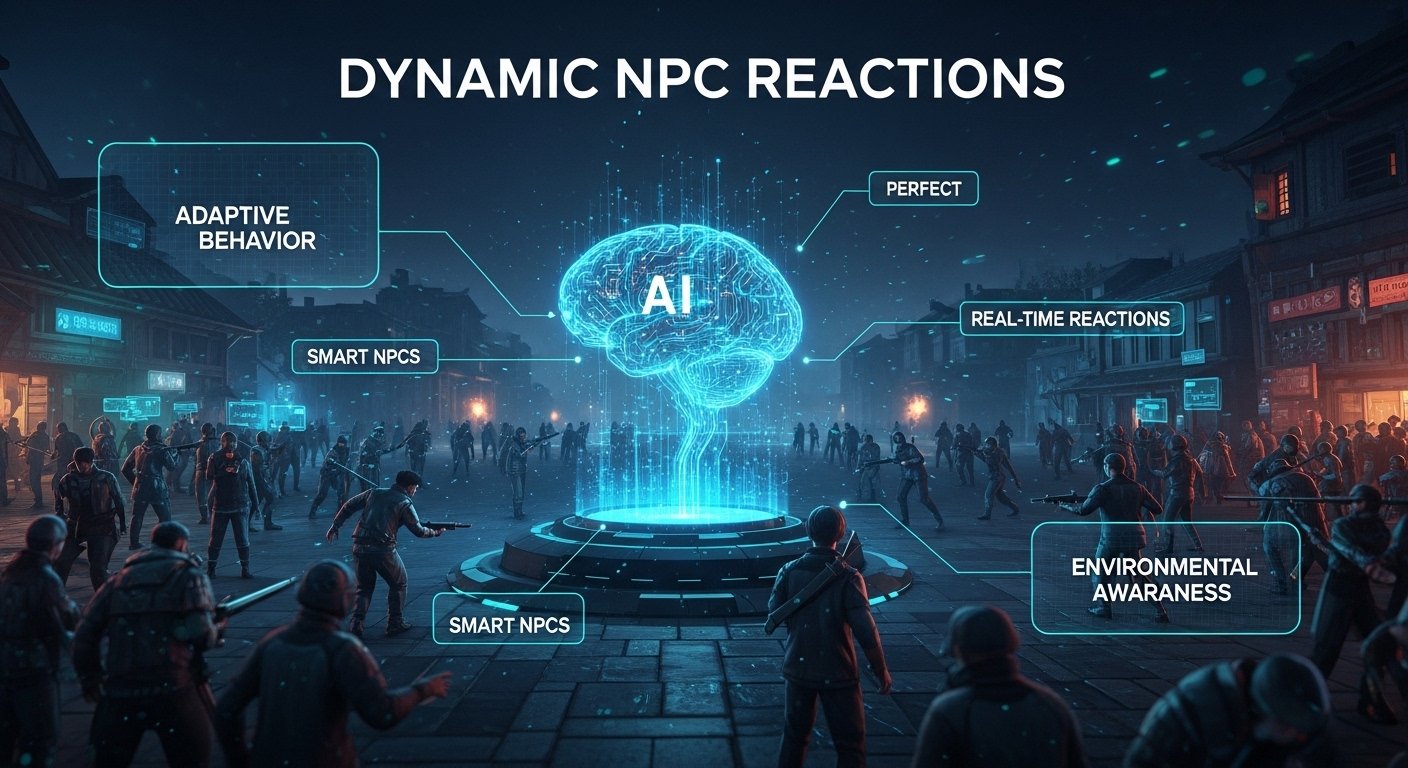
Dynamic NPC reactions fundamentally change this relationship. These systems enable characters to perceive their environment, interpret events, form opinions about the player, and respond accordingly. The technology transforms passive quest markers into something approaching actual inhabitants.
The difference feels immediately tangible when you experience it. Walk through a town covered in blood, and people react with fear. Perform heroic acts publicly, and strangers greet you warmly. Steal repeatedly, and merchants become suspicious. These responses create cause-and-effect relationships that make virtual worlds feel consequential.
The Technical Foundation
Understanding how dynamic reactions work requires breaking down several interconnected systems. Most implementations rely on perception models, memory systems, and behavior trees working in concert.
Perception models determine what NPCs can actually detect. Line of sight calculations establish visual awareness. Audio propagation systems let characters hear nearby events. Some games track smell or environmental disturbances. An NPC can only react to what their perception systems register.
Memory gives those perceptions lasting impact. Witness an NPC seeing you commit a crime, and that information persists in their memory. They might report you to authorities, refuse service, or cower when you approach days later. Without memory, every interaction would reset characters would greet their attacker warmly moments after an assault.
Behavior trees translate perception and memory into appropriate responses. These decision frameworks evaluate current conditions against possible actions. If the player is armed and has negative reputation, choose fearful behavior. If the player helped previously and is unarmed, choose friendly behavior. The trees can become extraordinarily complex, handling hundreds of potential conditions.
Modern implementations add emotional modeling on top. NPCs might have persistent mood states affecting their reactions. A grieving character responds differently than a content one, even to identical player actions.
Games That Got It Right
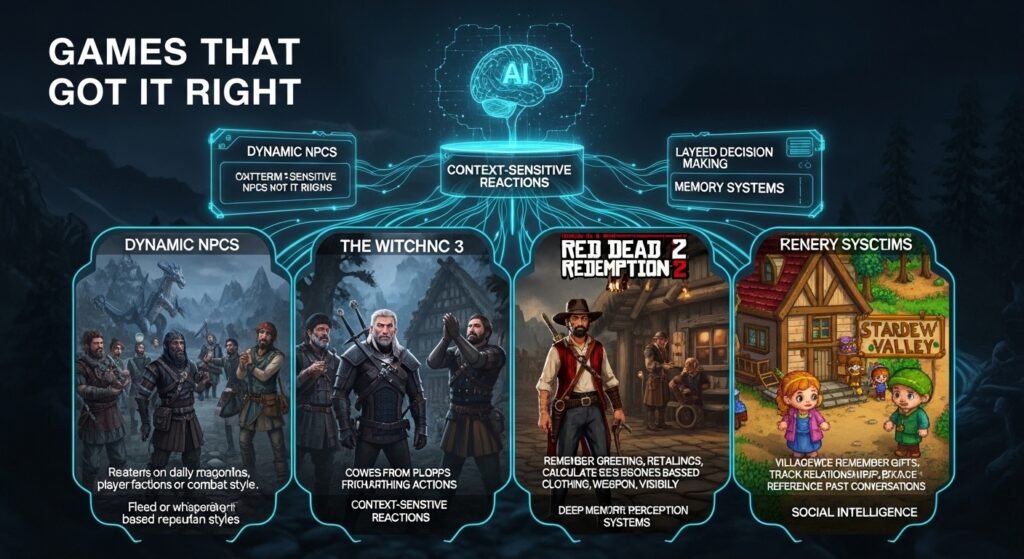
The Elder Scrolls V: Skyrim introduced many players to dynamic NPC reactions, though imperfectly. Its radiant AI system gave characters daily routines, basic perception, and memory. Guards would comment on your faction membership, thieves guild affiliation, or combat style. Citizens fled from dragons and whispered about your notorious deeds.
Skyrim’s limitations became obvious too. NPCs occasionally witnessed crimes through walls. Memory sometimes persisted illogically. Guards would forget bounties in adjacent territories. But as a mainstream introduction to dynamic reactions, it shifted player expectations permanently.
The Witcher 3 refined the concept through context-sensitive reactions. Peasants might applaud Geralt after witnessing him slay monsters, or cower from the frightening Witcher based on regional attitudes toward his profession. Shopkeepers adjusted prices based on local reputation. These touches made the world feel politically and socially coherent.
Red Dead Redemption 2 currently represents the benchmark. Every NPC exists within complex perception and memory systems. Greet strangers, and they’ll remember you favorably. Antagonize them, and they might seek revenge hours later. Witnesses to crimes can be intimidated, bribed, or eliminated each choice cascading through reputation systems. The game tracks details like your clothing cleanliness, weapon visibility, and even your horse’s condition when calculating NPC responses.
Smaller games sometimes achieve remarkable dynamic reactions through focused scope. Stardew Valley’s villagers remember gifts, track relationship development, and reference past conversations. The intimacy of a small cast allows deeper reaction modeling than massive open worlds can sustain.
Why This Matters for Immersion
Dynamic NPC reactions serve a crucial psychological function. They validate player existence within game worlds. When characters respond appropriately to your actions, you feel present rather than irrelevant. The world acknowledges you.
This acknowledgment creates investment. Players behave differently when they believe their actions have observers who remember. Some modify behavior to maintain positive reputations. Others deliberately test reaction systems, seeing how NPCs respond to increasingly outrageous conduct. Both engagement styles demonstrate that dynamic reactions successfully draw players deeper into fictional worlds.
Storytelling benefits tremendously as well. When NPCs react dynamically, narrative emerges organically from gameplay rather than existing solely in cutscenes. Your personal story how you’ve treated people, what you’ve accomplished, what crimes you’ve committed becomes visible in how the world responds to your presence.
Current Limitations Worth Acknowledging
Despite significant advances, dynamic NPC reactions remain constrained by computational resources and design complexity. Open world games especially struggle to give every character deep reaction modeling. Often, only named or important NPCs receive sophisticated systems while generic townspeople operate on simpler logic.
Consistency presents ongoing challenges. When thousands of NPCs must react plausibly to potentially infinite player behaviors, edge cases emerge constantly. Characters sometimes react nonsensically because their perception systems misread situations. Memory lapses create immersion breaks when severe crimes are inexplicably forgotten.
The uncanny valley of social intelligence also affects these systems. When NPCs react dynamically but imperfectly, the failures stand out more than if reactions were obviously scripted. Players develop expectations for realistic social behavior that current technology can’t fully satisfy.
Voice acting adds practical constraints. Recording dialogue for every possible reaction permutation would be prohibitively expensive. Games rely on generic lines that sometimes feel disconnected from specific contexts, undermining the dynamic systems beneath.
Looking Ahead
The trajectory seems clear. Each generation of games pushes NPC reaction sophistication further. Improved processing power enables tracking more variables simultaneously. Machine learning techniques allow NPCs to develop more nuanced behavioral patterns. Procedural dialogue generation might eventually supplement voice acting, creating truly contextual responses.
The ultimate goal NPCs indistinguishable from human social intelligence remains distant. But the journey toward that goal continues producing richer, more responsive game worlds. Every step makes virtual inhabitants feel slightly more alive.
For players, this evolution transforms gaming from experiencing authored content to genuinely inhabiting alternative realities. That transformation feels worth pursuing.
Frequently Asked Questions
What are dynamic NPC reactions?
Dynamic NPC reactions are systems allowing game characters to perceive player actions, remember events, and respond appropriately based on context rather than following purely scripted behaviors.
Which games have the best dynamic NPC reactions?
Red Dead Redemption 2 leads current implementations, with The Witcher 3, Skyrim, and various simulation games like Stardew Valley also featuring notable dynamic reaction systems.
How do NPCs remember player actions?
Games use memory systems that store relevant player behaviors—crimes committed, relationships formed, quests completed—then reference this data when determining NPC responses during future interactions.
Do dynamic reactions affect gameplay or just immersion?
Both. Dynamic reactions influence practical elements like shop prices, quest availability, and NPC assistance while also deepening immersion through believable social environments.
Why do NPCs sometimes react unrealistically?
Limitations in perception systems, memory management, and behavior tree complexity cause occasional failures where NPCs misread situations or respond inappropriately to edge cases.
Will NPC reactions become fully realistic someday?
Continuous improvement seems likely, though matching human social intelligence remains a distant goal requiring advances in multiple technologies including natural language processing and emotional modeling.