
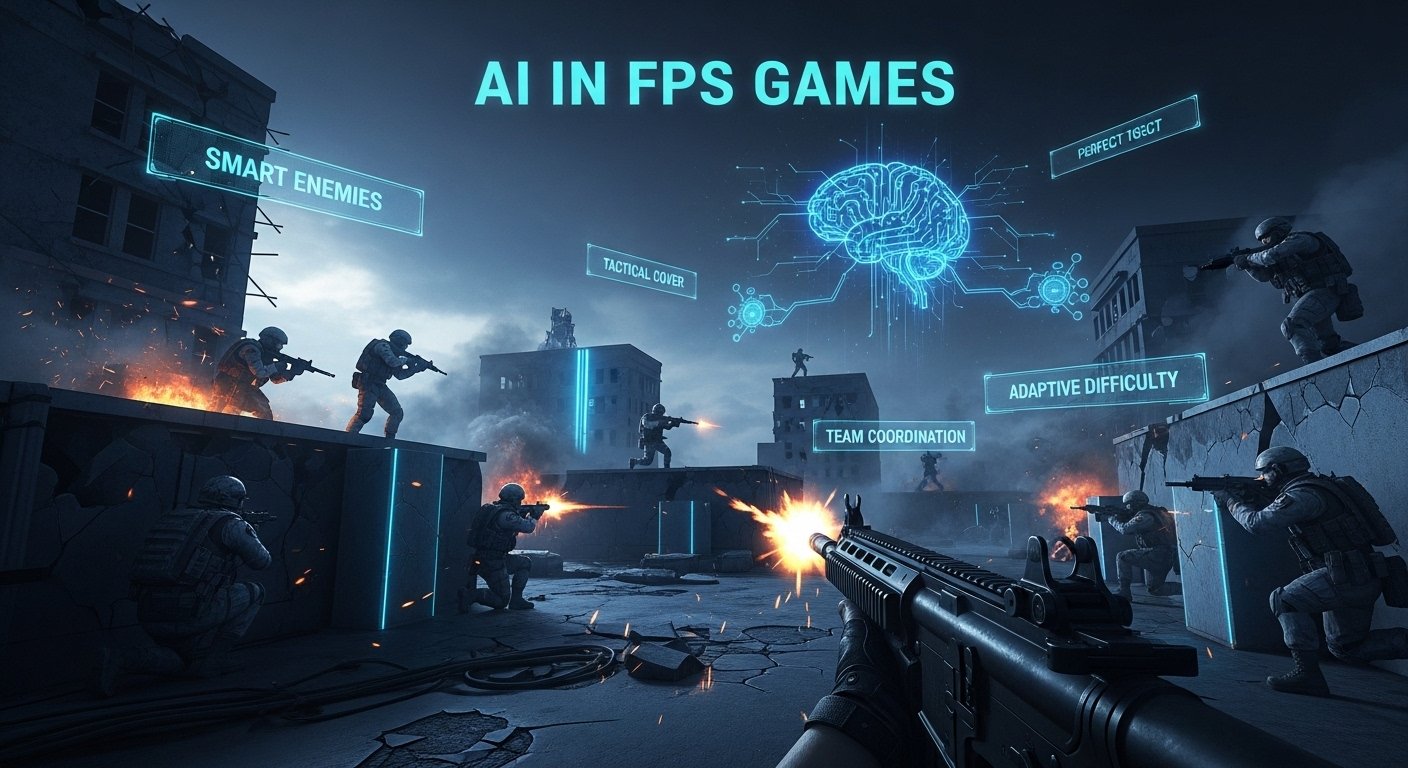
The first time an enemy actually scared me in a video game wasn’t a horror title. It was F.E.A.R., somewhere around 2005. I’d been pinned behind a concrete pillar when I heard footsteps circling around. Flanking me. Another soldier was suppressing my position while his squad mate moved to get an angle. When that grenade came sailing over my cover, I panicked genuinely panicked and sprinted into exactly the ambush they’d set up.
I died spectacularly. And I couldn’t stop grinning.
That moment taught me something fundamental about FPS game design: the best enemy AI doesn’t just challenge you it makes you believe you’re fighting something intelligent. After thousands of hours across countless shooters, I’ve come to appreciate just how difficult that illusion is to create.
What FPS AI Actually Does
First-person shooter AI handles a deceptively complex web of responsibilities. At the most basic level, enemies need to move through environments, aim at players, and fire weapons. Simple enough in theory. But the details matter enormously.
Good FPS AI must navigate three-dimensional spaces with obstacles, elevation changes, and destructible elements. It needs to decide when to advance, retreat, take cover, reload, or switch tactics entirely. It must coordinate with other AI entities to avoid clustered behavior that looks robotic. And crucially, it has to do all this while appearing neither omniscient nor stupid.
The perception systems alone require careful balancing. Can enemies see through smoke? How quickly do they spot you in peripheral vision versus direct line of sight? Do they hear footsteps, gunfire, explosions? These parameters directly impact whether combat feels fair or frustrating.
The Evolution I’ve Witnessed
Playing shooters across different eras reveals fascinating progress and some surprising regressions. Early titles like Doom and Quake featured enemies with minimal behavioral complexity. They moved toward you, shot when possible, and that was essentially it. The challenge came from enemy variety and level design rather than tactical sophistication.
GoldenEye 007 on N64 introduced broader audiences to enemies with patrol routes, alert states, and basic self-preservation instincts. Guards would actually flee when wounded. Revolutionary stuff for 1997.
Half-Life changed everything the following year. Valve’s military soldiers used squad tactics, communicated with each other through barked orders, and employed grenades to flush players from cover. The AI wasn’t actually as sophisticated as it felt clever level design and scripted sequences enhanced the illusion but the experience felt generations ahead of contemporaries.
Then came F.E.A.R. in 2005, which remains the gold standard for many enthusiasts. Monolith’s Goal Oriented Action Planning system created enemies that genuinely adapted to player behavior. They’d coordinate suppressing fire. They’d kick over furniture for cover. They’d retreat strategically and set up new defensive positions. Playing against those Replica soldiers felt like facing human opponents.
Halo: Combat Evolved and its sequels took a different approach, focusing on enemy personality rather than tactical realism. Elites fought with aggressive honor. Grunts panicked comedically when leaders fell. Jackals were cautious shield-bearers. Each encounter became readable through enemy behavior.
The Technical Foundations
Most FPS AI operates on layered decision systems. Perception handles what enemies can detect. Behavior trees or state machines determine reactions to perceived information. Navigation meshes (navmeshes) enable pathfinding through complex geometry.
Cover systems have become particularly sophisticated. Modern AI evaluates cover positions based on protection angles, distance from threats, fallback routes, and even sight lines to teammates. The best implementations make enemies seem genuinely aware of their tactical situation.
Animation integration matters more than players typically realize. AI decisions mean nothing if characters can’t execute them believably. The blend between decision-making and physical movement creates or destroys the illusion of intelligence. Stiff, robotic animations undermine even the smartest underlying systems.
Difficulty scaling presents ongoing design challenges. Easier settings typically adjust health values and aim accuracy, but truly elegant difficulty design modifies tactical behavior. Enemies might push more aggressively on harder settings, use abilities more frequently, or coordinate attacks more effectively.
Notable Implementations Worth Studying
Beyond F.E.A.R., several titles have pushed FPS AI forward meaningfully. The Metro series created tense encounters through enemy self-preservation human opponents who genuinely seemed to value their lives, surrendering when outgunned or fleeing when wounded badly.
Far Cry 2 attempted something ambitious with buddy systems and dynamic fire propagation that enemies actually responded to. Mercenaries would react to spreading flames, creating unpredictable combat scenarios. Implementation was inconsistent, but the ambition showed.
Doom Eternal took a completely different philosophy, designing enemies as puzzle pieces rather than tactical combatants. Each demon type forced specific player responses, creating combat that felt like violent chess. Not realistic, but incredibly satisfying.
The Last of Us Part II, though primarily third-person, deserves mention for named enemies who call out to each other, mourn fallen friends, and exhibit genuine fear. That humanization making enemies feel like people rather than targets represents a frontier many FPS games haven’t seriously explored.
Persistent Challenges
Let me be honest about limitations. FPS AI still struggles with several fundamental problems that become obvious during extended play.
Predictability remains the biggest issue. Spend enough time with any shooter and patterns emerge. Enemies use the same chokepoints, follow predictable patrol routes, respond identically to repeated scenarios. The illusion fades.
Companion AI often lags behind enemy AI significantly. I’ve lost count of friendly NPCs who blocked doorways, ran into my line of fire, or stood motionless during firefights. Creating believable allies apparently proves even harder than creating believable enemies.
Environmental interaction remains limited. Enemies rarely use destructible cover intelligently, struggle with dynamic level changes, and almost never employ the same creative approaches players discover. The gap between player possibility space and AI possibility space can feel jarring.
Multiplayer-focused shooters frequently neglect AI entirely. Bots in games like Counter-Strike or Valorant serve as placeholder practice nothing more. Understandable commercially, but disappointing for players who prefer offline experiences.
Where Things Are Heading
Modern development increasingly emphasizes systemic AI over scripted encounters. Games like Far Cry 6 and Dying Light 2 feature enemies responding to dynamic world states rather than predetermined scenarios.
Machine learning offers intriguing possibilities, though implementation in commercial products remains limited. Training AI to adapt genuinely to individual player tendencies could theoretically eliminate the predictability problem though balancing remains challenging.
Whatever approaches emerge, the goal stays constant: enemies that feel alive, that seem to think, that make victories feel earned. That’s what kept me playing after that F.E.A.R. ambush killed me. The soldiers felt real enough to respect.
And real enough to want revenge against.
Frequently Asked Questions
What is AI used for in FPS games?
AI controls enemy behavior including movement, combat tactics, cover usage, perception, coordination with other enemies, and responses to player actions.
Which FPS game has the best enemy AI?
F.E.A.R. (2005) is frequently cited as having exceptionally sophisticated tactical AI. Modern standouts include Metro Exodus and The Last of Us Part II.
Why do FPS enemies sometimes act stupidly?
Computational limitations, testing constraints, and design priorities mean AI can’t handle every situation. Edge cases often expose behavioral weaknesses.
Do harder difficulty settings improve AI intelligence?
Sometimes. Better-designed games modify tactical behavior on higher difficulties, while simpler implementations just increase damage and health values.
How do FPS enemies know where players are?
Through perception systems simulating sight and hearing. Well-designed games ensure enemies only react to information they could plausibly detect.
Will FPS AI continue improving?
Yes, though progress may emphasize systemic responsiveness and personality over raw tactical sophistication, creating more memorable rather than just smarter enemies.