
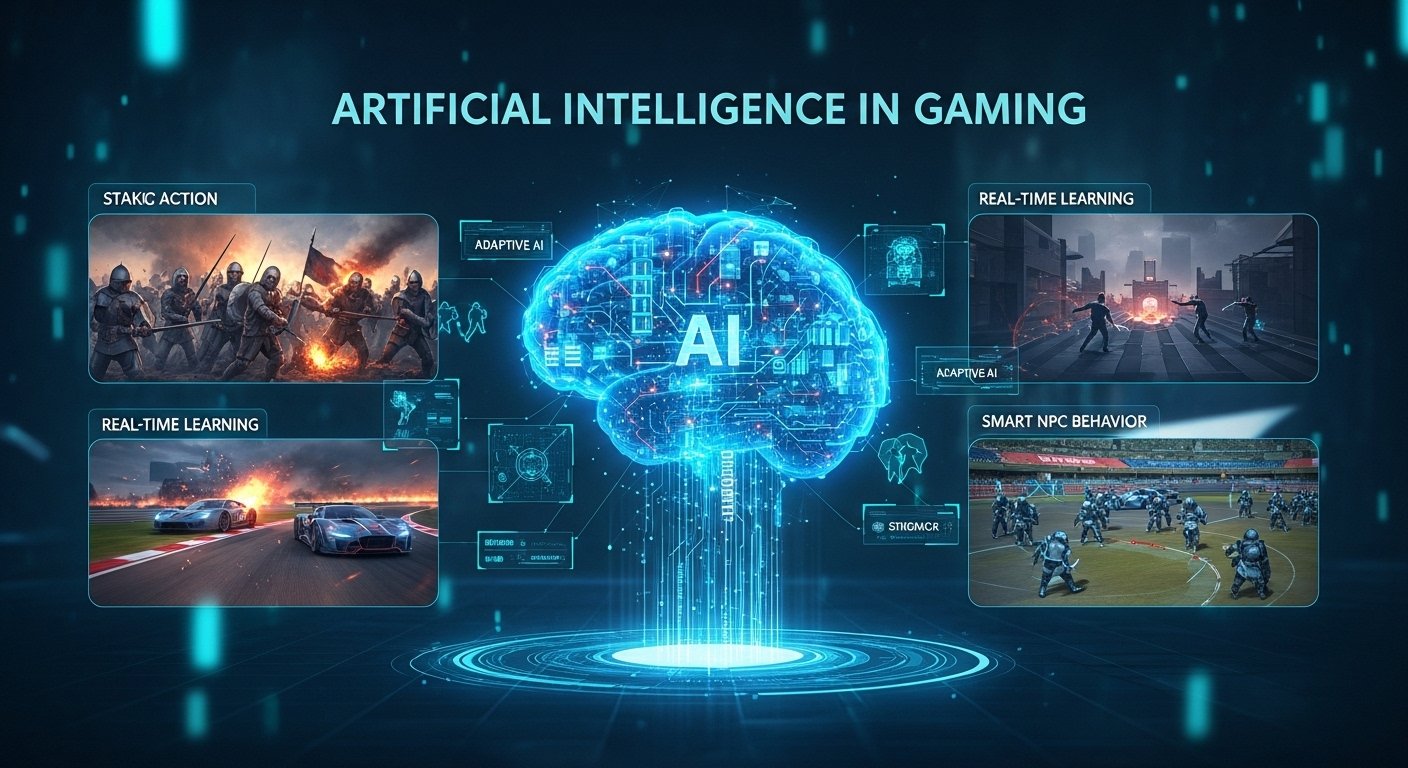
I’ve been covering the gaming industry for over a decade now, and honestly, nothing has transformed player experiences quite like artificial intelligence. What started as simple pathfinding algorithms in the early arcade days has evolved into something genuinely remarkable systems that learn, adapt, and create experiences we couldn’t have imagined twenty years ago.
Let me walk you through what’s actually happening behind the scenes and why it matters for everyone who picks up a controller.
The Evolution Nobody Saw Coming
Back when I first started analyzing game mechanics, enemy AI was laughably predictable. Enemies walked preset patterns, reacted to the same triggers, and died the same way every single time. We accepted it because we didn’t know better.
Fast forward to today, and we’re watching NPCs have conversations that feel surprisingly natural, opponents that study our playstyles, and entire virtual worlds that generate themselves based on player choices. The shift happened gradually, then all at once.
Games like The Last of Us Part II demonstrated what modern behavioral AI can accomplish. Enemies call out to each other by name, coordinate flanking maneuvers, and react with genuine panic when their friends fall. Playing through that game, I caught myself momentarily forgetting these weren’t real people making real decisions.
Procedural Generation: Where AI Gets Creative
One area that doesn’t get enough attention is procedural content generation. This is where AI algorithms create game content levels, quests, even entire landscapes on the fly.
No Man’s Sky remains the most ambitious example I’ve encountered personally. The game features over 18 quintillion planets, each with unique ecosystems, creatures, and terrain. No human team could handcraft that content in a thousand lifetimes. The AI handles it effortlessly, creating coherent worlds from mathematical seeds.
But here’s the trade-off many developers struggle with: procedurally generated content often lacks the intentional design of handcrafted experiences. A randomly generated dungeon might be technically interesting but miss the dramatic pacing a human designer would instinctively create. Studios are still finding that balance.
Adaptive Difficulty: The Invisible Hand
Remember dying repeatedly to the same boss and wondering if the game quietly made things easier? You weren’t imagining it.
Dynamic difficulty adjustment has become surprisingly sophisticated. Resident Evil 4 pioneered transparent difficulty scaling back in 2005, but modern implementations are far more nuanced. Left 4 Dead’s “AI Director” remains legendary among developers it monitors player performance in real-time, adjusting zombie spawns, supply placement, and intensity pacing to maintain optimal tension.
The controversy here is real, though. Some players feel cheated when games secretly adjust difficulty. There’s an ongoing debate in gaming communities about transparency versus immersion. Personally, I lean toward invisible systems that serve player enjoyment, but I understand why purists want full control.
Machine Learning Changes Everything
One area that doesn’t get enough attention is procedural content generation. This is where AI algorithms create game content levels, quests, even entire landscapes on the fly.
No Man’s Sky remains the most ambitious example I’ve encountered personally. The game features over 18 quintillion planets, each with unique ecosystems, creatures, and terrain. No human team could handcraft that content in a thousand lifetimes. The AI handles it effortlessly, creating coherent worlds from mathematical seeds.
But here’s the trade-off many developers struggle with: procedurally generated content often lacks the intentional design of handcrafted experiences. A randomly generated dungeon might be technically interesting but miss the dramatic pacing a human designer would instinctively create. Studios are still finding that balance.
Adaptive Difficulty: The Invisible Hand
Remember dying repeatedly to the same boss and wondering if the game quietly made things easier? You weren’t imagining it.
Dynamic difficulty adjustment has become surprisingly sophisticated. Resident Evil 4 pioneered transparent difficulty scaling back in 2005, but modern implementations are far more nuanced. Left 4 Dead’s “AI Director” remains legendary among developers it monitors player performance in real-time, adjusting zombie spawns, supply placement, and intensity pacing to maintain optimal tension.
The controversy here is real, though. Some players feel cheated when games secretly adjust difficulty. There’s an ongoing debate in gaming communities about transparency versus immersion. Personally, I lean toward invisible systems that serve player enjoyment, but I understand why purists want full control.
Machine Learning Changes Everything
Traditional game AI followed scripted rules: if player does X, respond with Y. Machine learning flipped that paradigm entirely.
DeepMind’s work with StarCraft II proved AI could master competitive gaming at superhuman levels. AlphaStar defeated professional players by developing strategies humans had never conceived. That research has practical applications developers now use similar approaches to playtest games more thoroughly than any human QA team could manage.
Racing games particularly benefit from this technology. Forza Horizon series uses “Drivatars” AI opponents trained on millions of actual player driving behaviors. They feel genuinely unpredictable because they’re essentially digital ghosts of real human tendencies.
The NPC Revolution
Non-player characters have always been gaming’s weakest link. They repeated dialogue endlessly, walked into walls, and generally reminded us we were playing a simulation.
That’s changing rapidly. Games now incorporate natural language processing that enables more dynamic conversations. While we haven’t reached fully convincing AI companions yet, the improvements are striking. Compare modern Fallout companions to those from a decade ago the emotional range and situational awareness have improved dramatically.
The technology powering smart assistants and chatbots has found its way into game development pipelines. Smaller indie studios can now implement conversational AI that once required massive budgets.
Ethical Considerations Worth Discussing
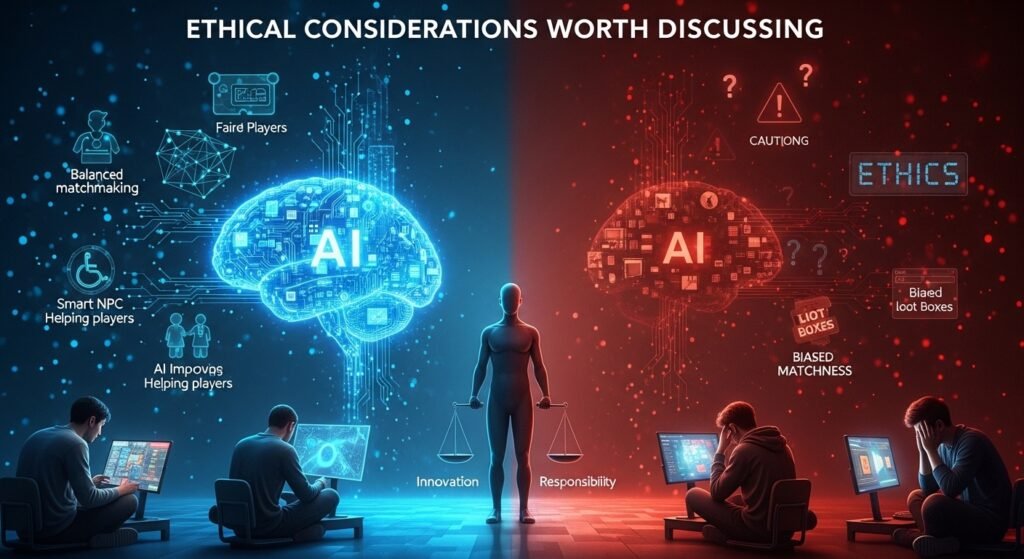
Not everything about AI in gaming deserves celebration. There are legitimate concerns worth acknowledging.
Data collection raises privacy questions. When games analyze player behavior to personalize experiences, what happens to that information? Gaming companies haven’t always been transparent about data practices.
The gambling-adjacent nature of AI-optimized engagement mechanics also troubles many researchers. When algorithms learn exactly which reward schedules keep players playing longest, we’ve entered murky ethical territory. Loot boxes and gacha systems often rely on AI optimization to maximize spending.
As someone who genuinely loves this industry, I think we need honest conversations about responsible implementation.
What Comes Next
The next five years will likely bring AI-generated voice acting, dynamically written storylines that respond to player choices, and virtual companions that remember our preferences across multiple games.
Cloud gaming enables another possibility: AI processing happens remotely on powerful servers rather than local hardware. This could bring console-quality AI experiences to mobile devices, expanding gaming audiences dramatically.
I’m cautiously optimistic. The technology creates remarkable opportunities for more immersive, personalized gaming experiences. But the industry must balance innovation with player wellbeing.
Final Thoughts
Artificial intelligence has become gaming’s most transformative force, quietly revolutionizing everything from enemy behaviors to world creation. The games we’ll play in 2030 will feel almost incomprehensible compared to today’s experiences just as current titles would have seemed impossible to developers in 2000.
That continuous evolution is exactly what makes this industry so exciting to cover.
Frequently Asked Questions
What is AI in gaming?
AI in gaming refers to techniques that make game elements behave intelligently controlling enemies, generating content, adjusting difficulty, and creating responsive NPCs.
How does AI improve gaming experiences?
AI creates more realistic opponents, adapts challenges to player skill levels, generates unique content, and enables natural conversations with game characters.
Can AI replace human game developers?
No. AI assists development but cannot replicate human creativity, storytelling instincts, or artistic vision that make games meaningful.
What games have the best AI?
The Last of Us Part II, Fear, Alien: Isolation, and the Halo series are frequently praised for exceptional enemy AI systems.
Is AI in games always good for players?
Not necessarily. AI-optimized engagement mechanics can encourage addictive behaviors and excessive spending if implemented irresponsibly.
Will AI make games too easy or too hard?
Properly implemented adaptive AI should create personalized challenge levels, keeping games engaging without becoming frusting.