
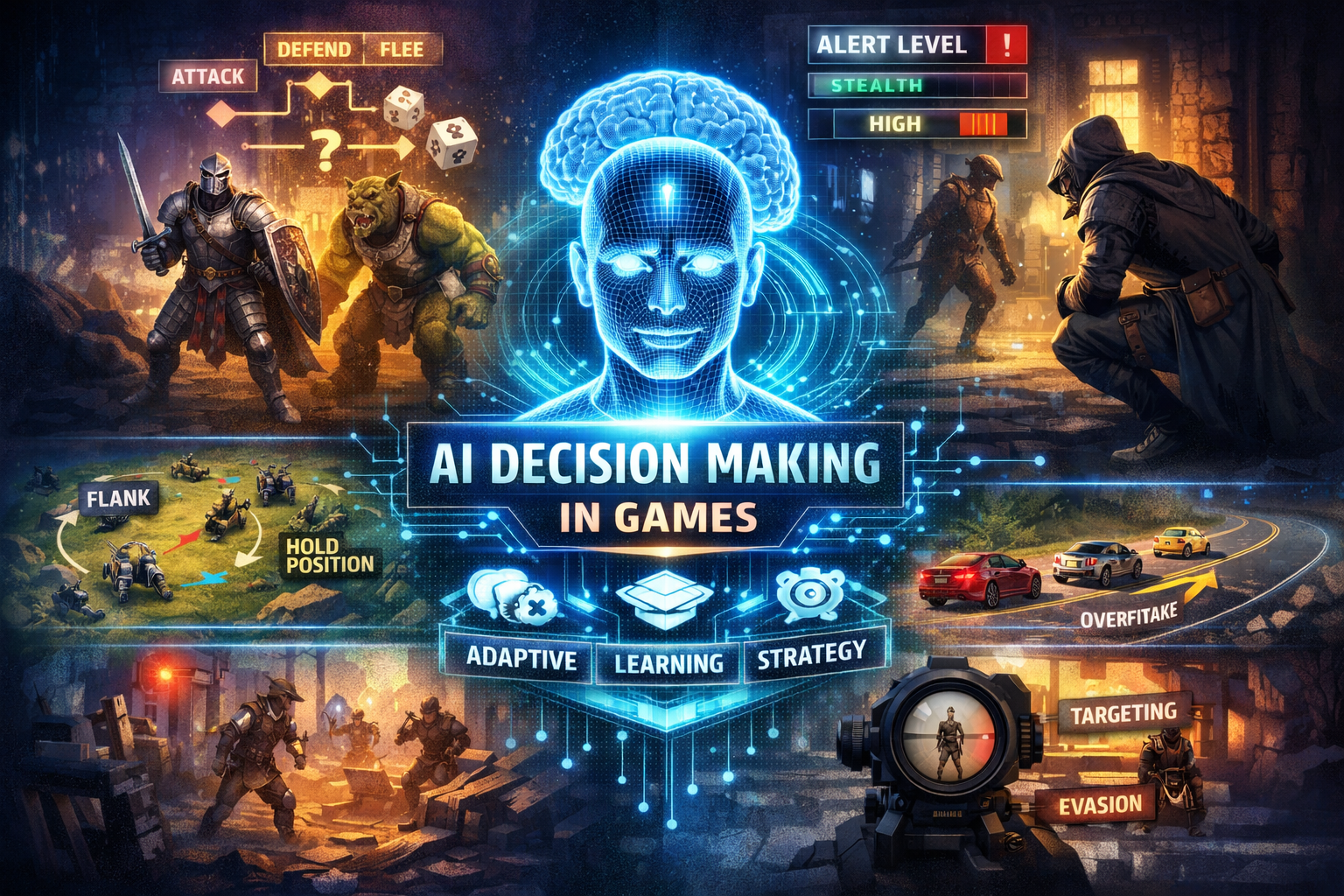
There’s a moment in every great game where you realize something clicked. The enemy didn’t just stand there waiting to get shot. It flanked you. It threw a grenade to flush you out. It retreated when outgunned and called for backup.
That’s when you know you’re facing a well-designed decision making system.
I’ve spent years studying how games create believable opponents and allies, and honestly, the engineering behind these systems fascinates me more than the flashy graphics everyone talks about. These invisible brains determine whether a game feels alive or robotic, challenging or frustrating, memorable or forgettable.
Let me pull back the curtain on how developers actually build these systems.
Understanding the Core Concept
At its heart, an AI decision making system is the logic framework that determines what a game character does at any given moment. Should the guard investigate that noise? Should the companion heal you or attack the enemy? Should the racing opponent take the risky shortcut or play it safe?
Every action you see an NPC take stems from these underlying systems evaluating situations and selecting responses. The complexity ranges wildly from simple if then rules to sophisticated probability calculations running hundreds of times per second.
What separates great games from mediocre ones often comes down to how thoughtfully these decision architectures are constructed.
The Building Blocks: Common Approaches
Finite State Machines
This remains the workhorse of game AI, despite being decades old. Think of it as a flowchart living inside every character. A guard might exist in states like “patrolling,” “suspicious,” “searching,” or “combat.” Specific triggers shift them between states hearing footsteps moves them from patrolling to suspicious, spotting the player shifts them to combat.
The original Metal Gear Solid used finite state machines beautifully. Guards followed predictable patterns until something disrupted their routine. The beauty was transparency; players could learn the rules and exploit them strategically.
The limitation? Characters feel mechanical when state transitions become too obvious. Players start seeing the system rather than the character.
Behavior Trees
This approach structures decisions as branching trees of conditions and actions. The system continuously evaluates branches from top to bottom, executing the first valid action it finds.
Halo’s Covenant enemies famously use behavior tree variations. Grunts panic when Elites die because their behavior tree prioritizes leadership presence. Remove that condition, and lower-priority “flee” behaviors activate. The result feels organic even though it’s entirely systematic.
Developers love behavior trees because they’re modular. You can add new behaviors without rewriting entire systems. The Unreal Engine includes robust behavior tree tools precisely because the approach scales so well.
Utility Systems
Here’s where things get interesting. Utility-based AI assigns numerical scores to every possible action based on current circumstances. The character performs whichever action scores highest at that moment.
The Sims franchise pioneered consumer-facing utility systems. Every need hunger, social, bladder carries a value. Sims constantly evaluate which action satisfies their most pressing needs. That’s why your Sim sometimes makes bizarre choices; the math prioritized something you didn’t expect.
Dragon Age: Inquisition gave players direct access to companion utility systems through tactical settings. You could literally program party members’ priorities attack strongest enemy, conserve mana, protect weakest ally. Watching your configurations play out in combat felt incredibly satisfying.
Real-World Implementation Challenges
Building these systems sounds straightforward on paper. Reality proves messier.
I talked with an indie developer last year who spent three months just tuning enemy aggression values. Too aggressive and players felt overwhelmed. Too passive and combat lost tension. Finding that sweet spot required thousands of playtests and countless parameter adjustments.
Performance constraints add another layer of difficulty. Every decision calculation consumes processing power. When you’ve got fifty NPCs making choices simultaneously in an open-world game, optimization becomes critical. Developers often implement “level of detail” systems for AI characters far from players run simplified decision-making while nearby characters use full complexity.
Then there’s the emergence problem. Sometimes decision systems interact in unintended ways. Bethesda games became famous for NPCs doing ridiculous things guards ignoring dragons, shopkeepers walking into fires because multiple AI systems conflicted with each other. What seems logical in isolation produces chaos when systems overlap.
The Player Experience Perspective
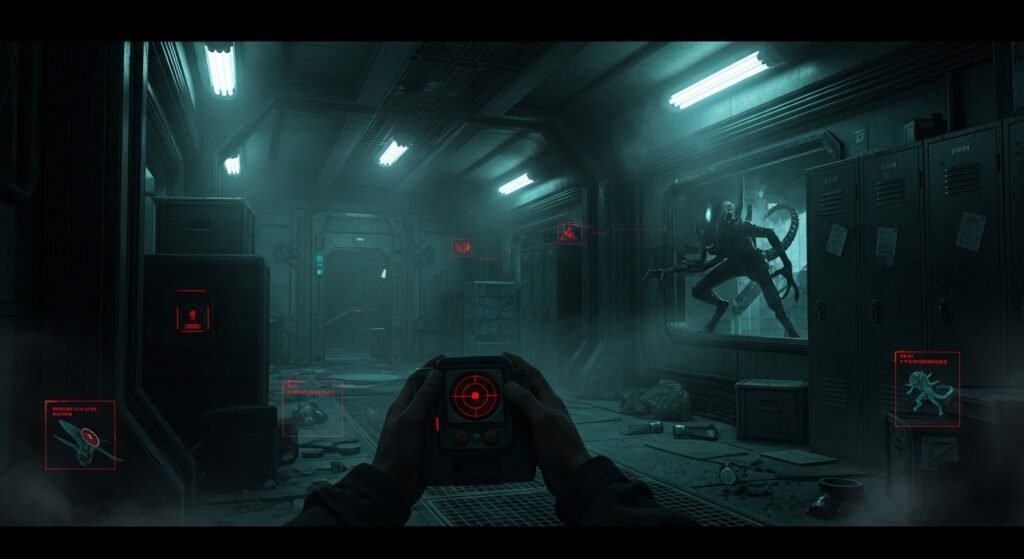
Good decision-making systems remain invisible to players. We shouldn’t see the machinery; we should feel the character.
Alien: Isolation nailed this balance. The xenomorph uses layered decision-making that players rarely consciously analyze. You just know it’s hunting you intelligently. It checks hiding spots you’ve used before. It listens for noise you make. It learns.
Except it doesn’t really learn not in the machine learning sense. The developers designed tiered behavior systems that gradually unlock more aggressive search patterns the longer encounters last. It creates the illusion of a learning predator through carefully structured decision escalation.
That’s the art of it. Making mathematical systems feel alive.
Where Things Are Heading
Modern decision making systems increasingly incorporate probabilistic elements. Rather than always choosing the “best” action, characters sometimes pick suboptimal options just like humans do. This unpredictability makes opponents feel less like calculators and more like thinking beings.
Some studios experiment with neural network approaches, training decision systems through thousands of simulated encounters. The results can be impressive but also unpredictable. Quality assurance becomes nightmarish when you can’t fully predict what decisions the AI might make.
Squad-based tactics present the current frontier. Games like Ghost Recon and XCOM demand AI that coordinates multiple characters with complementary roles. That requires decision systems that communicate, share information, and execute joint strategies. The computational complexity multiplies quickly.
Final Thoughts
Every memorable gaming moment involving NPCs every clever ambush, every surprising ally behavior, every villain that felt genuinely threatening stems from decision-making systems built by developers who understood both technology and human psychology.
These systems represent game development’s most underappreciated craft. They receive less attention than graphics or music, yet they fundamentally shape how games feel to play.
Next time an enemy outsmarts you, take a moment to appreciate the invisible architecture making that moment possible.
Frequently Asked Questions
What is an AI decision-making system in games?
It’s the underlying logic framework that determines what actions NPCs take based on game situations, player behavior, and environmental conditions.
What’s the difference between finite state machines and behavior trees?
Finite state machines use distinct states with specific transitions, while behavior trees evaluate branching condition chains to select actions hierarchically.
Do game enemies actually learn from players?
Most don’t truly learn through machine learning. They use cleverly designed systems that create the illusion of adaptation through conditional logic.
Why do some game NPCs behave stupidly?
Usually because multiple decision systems conflict, performance optimizations simplify logic, or edge cases weren’t anticipated during development.
Which games have the best AI decision-making?
Alien: Isolation, F.E.A.R., Halo series, and The Last of Us Part II are frequently cited for exceptional enemy decision-making systems.
Can players influence NPC decision-making?
Some games expose these systems directly through companion tactics settings, allowing players to adjust priority values and behavior preferences.