
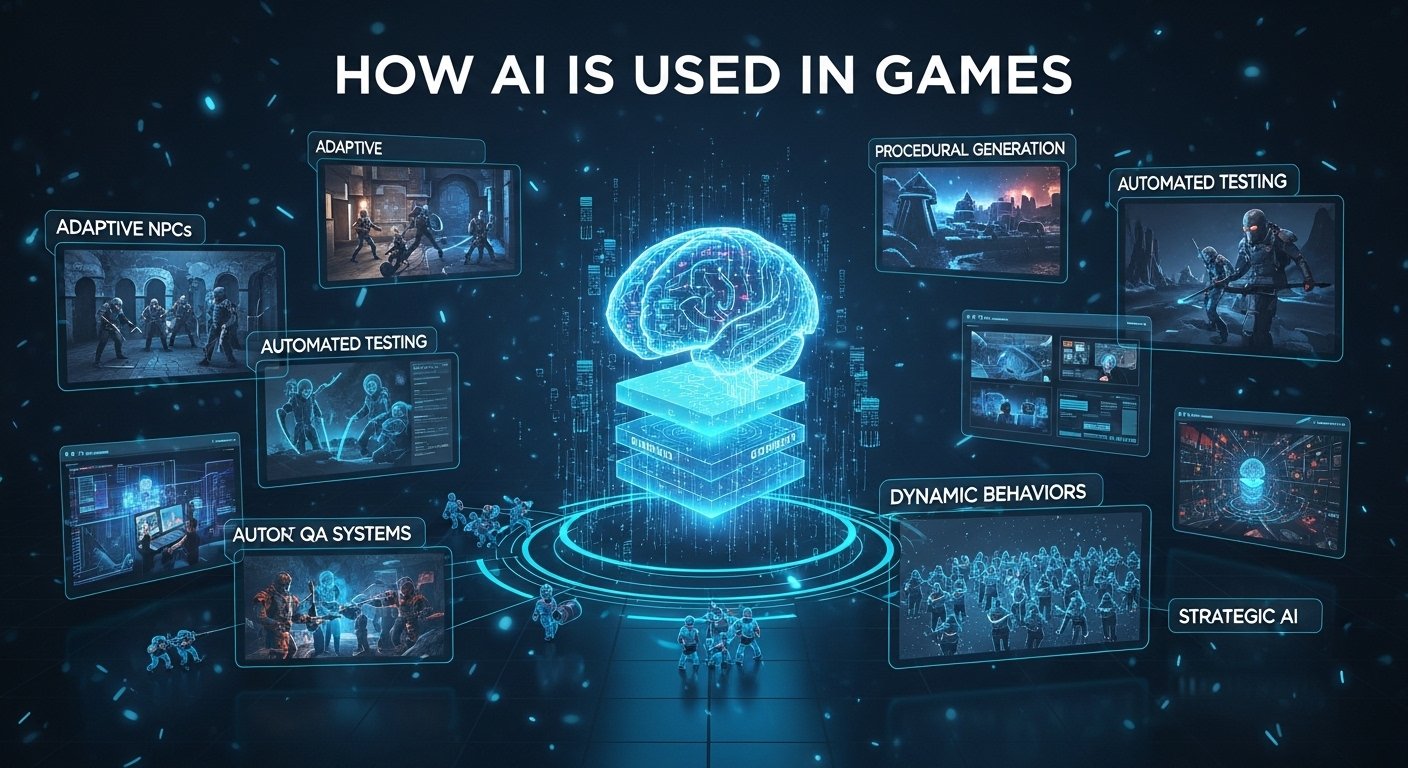
When people hear “AI in games,” their minds usually jump to enemy characters chasing them through corridors. Fair enough that’s the most visible application. But after years of following game development and speaking with designers, I’ve come to appreciate just how deeply artificial intelligence permeates modern gaming. It touches nearly everything, often in ways players never consciously notice.
The reality is far more interesting than simple enemy behavior. AI determines how your character’s hair moves, generates entire planets you’ll explore, tests games before humans ever touch them, and even predicts what content you’ll enjoy most. Let’s dig into how this technology actually shapes gaming experiences.
Enemy and NPC Behavior: The Obvious Starting Point
Yes, let’s address the elephant in the room first. Non-player character behavior remains AI’s most recognizable gaming application, and the sophistication has grown remarkably over time.
Modern NPCs operate on layered decision-making systems. Behavior trees allow characters to evaluate situations hierarchically checking for threats, assessing options, selecting appropriate responses. The guards in Hitman don’t just patrol; they investigate disturbances, communicate with colleagues, and remember suspicious activity.
What impresses me most about contemporary NPC AI is emotional simulation. The Last of Us Part II featured enemies who called out fallen companions by name, retreating when overwhelmed and becoming reckless when cornered. These touches transform generic opponents into something approaching characters.
Companion AI presents unique challenges. Elizabeth in BioShock Infinite needed to accompany players without becoming frustrating. She couldn’t block doorways, steal kills, or require constant babysitting. Developers spent enormous effort making her helpful without being intrusive throwing ammunition, finding cover, commenting contextually on environments.
Pathfinding: Getting from A to B Intelligently
Every time a character navigates around obstacles, pathfinding algorithms are working overtime. This sounds mundane until you consider the complexity involved.
Navigation mesh systems NavMesh in industry shorthand create invisible walkable surfaces that AI characters use for movement planning. A* algorithms calculate optimal routes between points, accounting for obstacles, terrain costs, and dynamic elements.
Games like Assassin’s Creed handle pathfinding across massive open worlds with thousands of NPCs moving simultaneously. Each character needs viable routes without consuming processing power that graphics and physics systems desperately need. The optimization involved is genuinely impressive engineering.
Watch Dogs 2’s traffic systems demonstrated sophisticated emergent pathfinding. Vehicles responded to accidents, construction, player chaos rerouting dynamically through simulated city infrastructure. Small detail, huge immersion impact.
Procedural Content Generation
Here’s where AI gets genuinely creative. Procedural generation uses algorithms to create game content levels, weapons, quests, entire worlds rather than hand crafting everything manually.
No Man’s Sky remains the most ambitious example. Eighteen quintillion planets, each with distinct geography, flora, fauna, and atmospheres. Human designers couldn’t possibly create that volume manually. Instead, sophisticated algorithms combining mathematical functions with artistic constraints generate endless variety.
Roguelikes depend entirely on procedural generation. Each Hades run features different room layouts, enemy combinations, and reward sequences. Spelunky builds new caves every attempt. These systems keep experiences fresh across hundreds of hours.
Minecraft’s world generation deserves mention too. Biomes blend naturally, cave systems sprawl believably, villages appear in sensible locations. The algorithm mimics geological and ecological patterns, creating spaces that feel designed even though they’re mathematically generated.
Adaptive Difficulty and Player Modeling
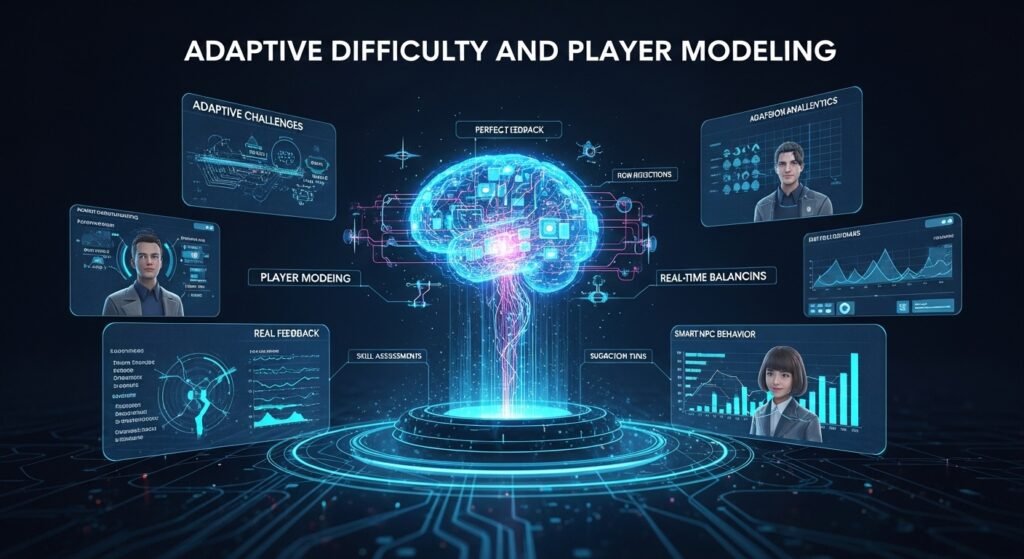
Smart games watch how you play and adjust accordingly. This application of AI has transformed accessibility and engagement.
Left 4 Dead’s Director system pioneered dynamic difficulty, monitoring player performance and orchestrating zombie encounters accordingly. Struggling? Fewer special infected, more supplies. Dominating? Relentless pressure. The system maintained tension without frustrating players.
Resident Evil 4 quietly adjusted enemy aggression based on player deaths and damage taken. Many players completed the game never realizing difficulty was flexing around their performance.
Player modeling takes this further, building profiles of individual preferences and behaviors. Some games track which content you engage with most, surfacing similar experiences. Others predict frustration points and intervene before players quit.
Animation and Physics Enhancement
AI increasingly influences how characters move and interact with environments. Traditional animation requires hand-crafting movements for every possible action. Machine learning offers alternatives.
Motion matching systems analyze massive databases of captured movements, selecting and blending appropriate animations based on player input and context. The Last of Us Part II used these techniques to create remarkably natural character movement that responded fluidly to terrain and situations.
Ragdoll physics often incorporate AI elements, determining how bodies respond to impacts realistically. Euphoria engine used in Grand Theft Auto and Red Dead Redemption simulates muscle tension and reflexive movement, creating unique reactions to every collision rather than canned death animations.
Testing and Quality Assurance
This application rarely gets attention, but AI has transformed game testing. Modern titles are too vast for human testers to explore comprehensively.
Automated testing bots play games continuously, exploring environments, triggering interactions, and logging issues. They find geometry holes, stuck points, and progression blockers that manual testing might miss. Electronic Arts uses sophisticated bot systems to stress-test multiplayer servers before launch.
Machine learning can identify patterns in crash reports, prioritizing bugs by frequency and severity. It spots graphical glitches, audio desynchronization, and performance drops across hardware configurations human testers couldn’t possibly cover.
Voice and Dialogue Systems
Natural language processing is entering gaming gradually. Some titles experiment with conversational AI that responds to spoken or typed player input rather than predefined dialogue trees.
While fully dynamic conversation remains limited, games increasingly use AI for voice synthesis and localization. Generating voice variants, adjusting delivery based on context, and even creating entirely synthetic voice performances are becoming technically feasible.
The ethical questions here are significant. Voice actor compensation, consent, and creative control remain unsettled as synthetic alternatives become viable.
Current Limitations and Honest Assessment
AI in games isn’t magic. Significant limitations persist.
Processing budgets force compromises. Sophisticated AI competes with graphics, physics, and networking for computational resources. Open-world games particularly struggle hundreds of characters can’t all run complex decision-making simultaneously.
Creativity remains elusive. AI can combine existing elements and follow patterns but struggles to generate genuinely novel experiences. Procedural generation produces variety, not necessarily quality. Hand crafted content still surpasses algorithmic generation in many contexts.
Unpredictability cuts both ways. Emergent AI behavior creates memorable moments but also bugs and exploits. Balancing sophistication against reliability requires constant tradeoff decisions.
Looking Ahead
The trajectory is clear: AI will become more pervasive, sophisticated, and invisible. Better hardware enables more complex systems. Machine learning techniques continue maturing. Player expectations keep rising.
I’m particularly excited about potential applications in personalized narrative stories that adapt meaningfully to individual player choices and preferences. Also promising: AI that genuinely learns from player behavior rather than applying predetermined responses.
The games industry has always pushed AI research forward. That symbiosis will only deepen.
FAQs
Is game AI the same as real AI?
Not really. Game AI prioritizes entertainment over intelligence. It creates illusions of smart behavior rather than achieving genuine understanding or reasoning.
Why do NPCs sometimes act stupidly?
Processing limitations, edge cases developers didn’t anticipate, or intentional design choices balancing realism against fun. Perfect AI isn’t always enjoyable.
Do games use machine learning?
Increasingly yes, particularly for animation, testing, and player modeling. Traditional algorithms still dominate real-time gameplay decisions.
What’s the most advanced AI in games currently?
F.E.A.R.’s tactical AI, Left 4 Dead’s Director, and recent immersive sims like Hitman represent high watermarks. Definition of “advanced” varies by application.
Can game AI actually learn?
Some systems adapt to player behavior within sessions. True persistent learning across playthroughs remains rare due to unpredictability concerns.
Will AI replace game developers?
Unlikely soon. AI assists development but lacks creative vision. Tools will improve, but human direction remains essential for meaningful experience.