
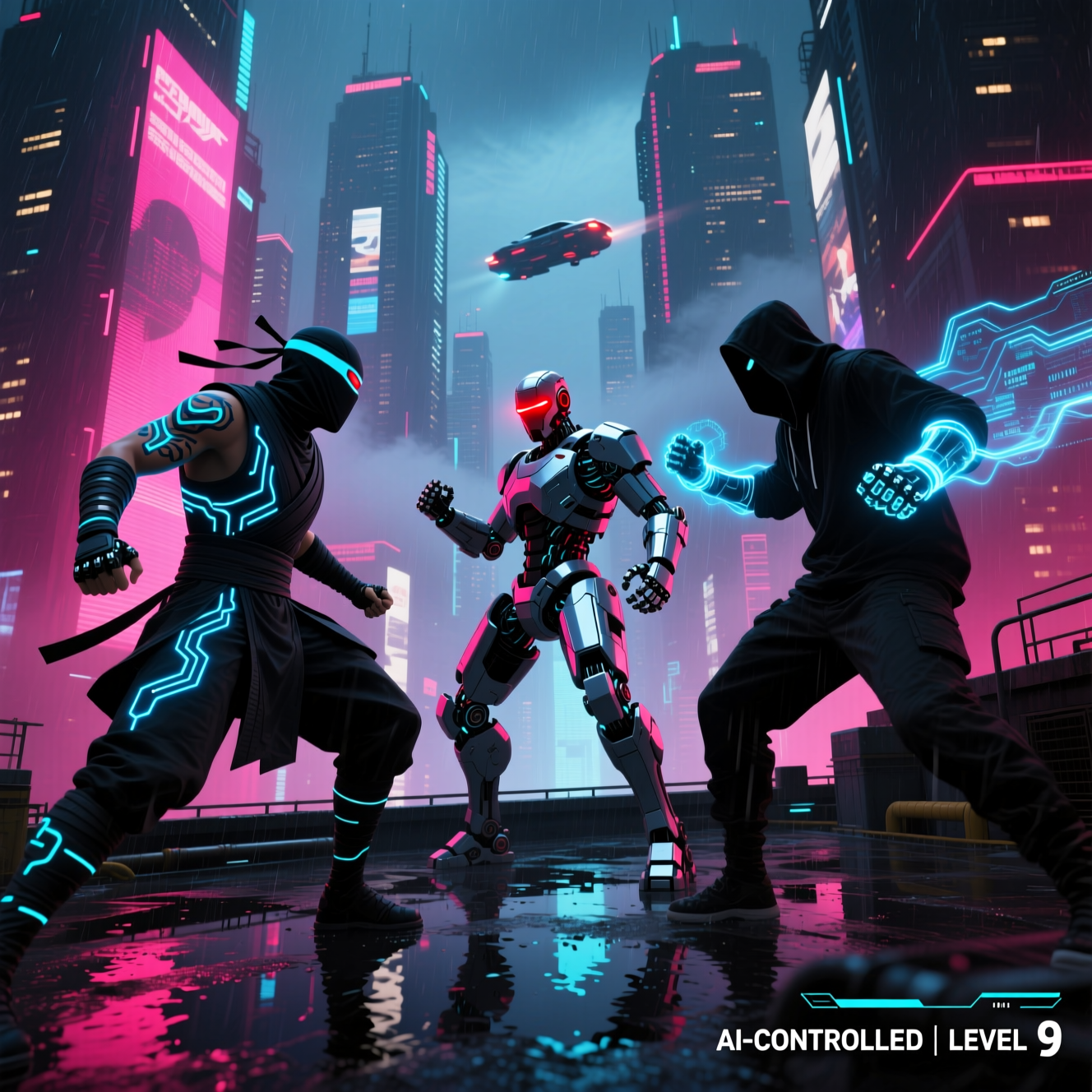
There’s a moment in Red Dead Redemption 2 that stuck with me for weeks. I was riding through Valentine when a drunk stumbled out of a saloon, bumped into a passerby, and sparked an argument that escalated into a fistfight. Neither character was relevant to any mission. Nobody scripted that encounter for my benefit. The game world simply lived, breathed, and generated drama without my involvement.
That’s the magic of well crafted AI controlled characters. They transform static environments into living spaces. After spending years studying how developers bring these digital inhabitants to life, I’ve developed deep appreciation for just how much craft goes into making virtual beings feel genuine.
Beyond Enemies: The Full Spectrum of AI Characters
When discussing AI controlled characters, most conversations default to enemies. Fair enough they’re the most interactive examples. But the ecosystem extends far beyond opposition.
Companions travel alongside players, requiring fundamentally different design priorities. They need to help without stealing glory, stay close without obstructing, and provide personality without becoming irritating across dozens of hours. Ellie from The Last of Us walks this tightrope brilliantly offering assistance, commentary, and emotional connection without becoming a liability.
Ambient NPCs populate world spaces, creating atmosphere and believability. The citizens of Night City in Cyberpunk 2077, despite launch controversies, contribute essential urban energy. Markets need shoppers. Streets need pedestrians. Without these background characters, cities feel abandoned regardless of architectural beauty.
Quest givers and merchants occupy middle ground functional characters requiring enough personality to be memorable without demanding extensive development resources. The Witcher 3 excelled here, making even minor characters feel distinct through voice performance and contextual dialogue.
Crowd systems simulate masses during concerts, battles, or sporting events. These characters sacrifice individual complexity for collective behavior, creating spectacle through sheer numbers and coordinated movement.
The Architecture of Digital Minds
How do AI characters actually work? The systems vary by purpose, but several foundational approaches dominate game development.
Finite state machines represent the simplest architecture. Characters exist in defined states patrolling, suspicious, attacking, fleeing with conditions triggering transitions between them. A guard patrols until detecting the player, becomes suspicious, investigates, then either returns to patrolling or escalates to combat. Simple, predictable, but effective for basic characters.
Behavior trees offer increased sophistication. Rather than linear state transitions, characters evaluate branching decision hierarchies. They assess situations, prioritize options, and select contextually appropriate responses. Halo’s Covenant enemies used early versions of these systems, explaining why combat felt more dynamic than contemporaries.
Utility systems take another approach, scoring potential actions and selecting highest-value options. A character might evaluate “attack player” at 70 points, “seek cover” at 85 points, and “retreat” at 40 points choosing cover as optimal response. These values shift dynamically based on circumstances.
Goal-oriented action planning lets characters work backward from objectives. Given a goal say, “eliminate intruder” the system identifies necessary steps and available actions, constructing plans that achieve objectives. F.E.A.R. pioneered this approach, producing tactical behaviors that still impress players today.
The Evolution of Character Intelligence
Early gaming featured simple AI out of necessity. Space Invaders aliens moved in patterns. Pac-Man ghosts followed basic rules. Processing limitations prevented complexity.
The 3D era brought dramatic advances. GoldenEye 007 enemies reacted to shots, investigated disturbances, and used cover revolutionary for 1997. Half Life featured soldiers who flanked, communicated, and flushed players from positions with grenades.
Open-world games pushed boundaries further. Grand Theft Auto III’s Liberty City needed characters who drove, walked, reacted to crime, and populated a living city. Each subsequent entry expanded these simulations.
Current-generation titles achieve remarkable believability. NPCs remember interactions across sessions. Characters maintain schedules, relationships, and preferences. Emotional states influence behavior visibly. The gap between scripted characters and AI-driven ones has narrowed substantially.
Memorable Examples Worth Studying
Certain games deserve recognition for exceptional AI character implementation.
Red Dead Redemption 2 set new standards for ambient AI. Characters respond to weather, time of day, player reputation, and countless contextual factors. Witnesses report crimes. Shopkeepers remember rudeness. Wildlife exhibits survival behaviors. The world feels genuinely inhabited.
Alien: Isolation featured a singular AI-controlled antagonist that learned player tendencies. Hide in lockers repeatedly? The Alien starts checking them. Use the motion tracker constantly? It learns to identify that sound. This created personalized terror that static AI couldn’t achieve.
The Elder Scrolls V: Skyrim demonstrated ambitious NPC scheduling. Characters maintained daily routines working, eating, sleeping, socializing. The system had obvious limitations and generated countless meme-worthy glitches, but the ambition influenced industry expectations permanently.
Middle-earth: Shadow of Mordor introduced the Nemesis System, giving enemy characters memory, personality, and ongoing relationships with the player. Enemies who killed you gained power and remembered the encounter. This transformed generic orcs into personal rivals with narrative weight.
Design Challenges Nobody Warns You About
Creating convincing AI characters involves constant compromise and unexpected problems.
The uncanny valley applies to behavior, not just appearance. Characters acting almost realistically but failing in subtle ways feel creepier than obviously artificial ones. Designers must choose between stylized consistency or realistic ambition that risks this valley.
Resource allocation creates brutal tradeoffs. Complex AI consumes processing power that graphics and physics desperately need. Open-world games particularly struggle they need hundreds of characters behaving simultaneously without tanking frame rates.
Testing emergent behavior becomes nightmarish as complexity increases. Characters interacting with each other, environments, and players create combinatorial possibilities impossible to anticipate. Bugs emerge from interactions nobody predicted.
Predictability versus believability tensions require careful balancing. Players need to understand AI responses for fair gameplay, but predictable characters feel robotic. Finding middle ground demands extensive iteration.
Ethical Considerations Worth Mentioning
As AI characters become more convincing, ethical questions emerge.
Violent games feature increasingly realistic human characters. When NPCs plead, express fear, or demonstrate personality before players harm them, the moral dynamics shift. Some games use this intentionally for thematic impact; others seem oblivious to implications.
Representation matters in AI populations too. Which characters receive complexity versus stereotypical simplicity reflects developer assumptions and biases. Ambient crowds particularly deserve scrutiny who populates these spaces, and how are various demographics portrayed?
Voice actor compensation becomes relevant as synthetic voices improve. AI characters might eventually feature generated performances rather than human recordings. The industry hasn’t resolved how to handle this transition fairly.
What Comes Next
The trajectory points toward increasing sophistication. Better hardware enables more complex simulation. Machine learning techniques offer new possibilities for adaptive behavior. Player expectations continuously rise.
I’m particularly interested in emotional modeling advances characters that maintain psychological states influencing long-term behavior rather than just immediate reactions. Imagine NPCs who hold grudges, develop trust gradually, or form relationships based on accumulated interactions.
Procedural personality generation also shows promise. Rather than designing individual characters, developers might create systems generating infinite variations with consistent internal logic.
Whatever emerges, AI controlled characters will remain essential to gaming’s unique capacity for living, responsive worlds. They’re the population of our virtual spaces, and they deserve the attention developers increasingly give them.
FAQs
What makes AI characters feel realistic?
Consistent behavior logic, contextual responses, visible emotional states, and memory of previous interactions all contribute. Technical execution matters less than behavioral coherence.
Why do NPCs sometimes act strangely?
Edge cases developers didn’t anticipate, conflicting behavioral priorities, or processing limitations forcing simplified decisions. Complex systems produce unexpected emergent behaviors.
Do AI characters actually think?
No. They follow programmed rules and decision trees. The appearance of thought comes from well-designed systems, not genuine cognition or understanding.
What game has the best AI characters?
Subjective, but Red Dead Redemption 2, The Last of Us series, and Hitman frequently receive praise for different character types and applications.
Can AI characters learn from players?
Some systems adapt to player tendencies within sessions. True persistent learning remains uncommon due to balance concerns and unpredictability risks.
Why are companion characters often frustrating?
Companions must navigate complex environments, assist without trivializing challenges, and avoid obstructing players—extremely difficult design constraints to satisfy simultaneously.