
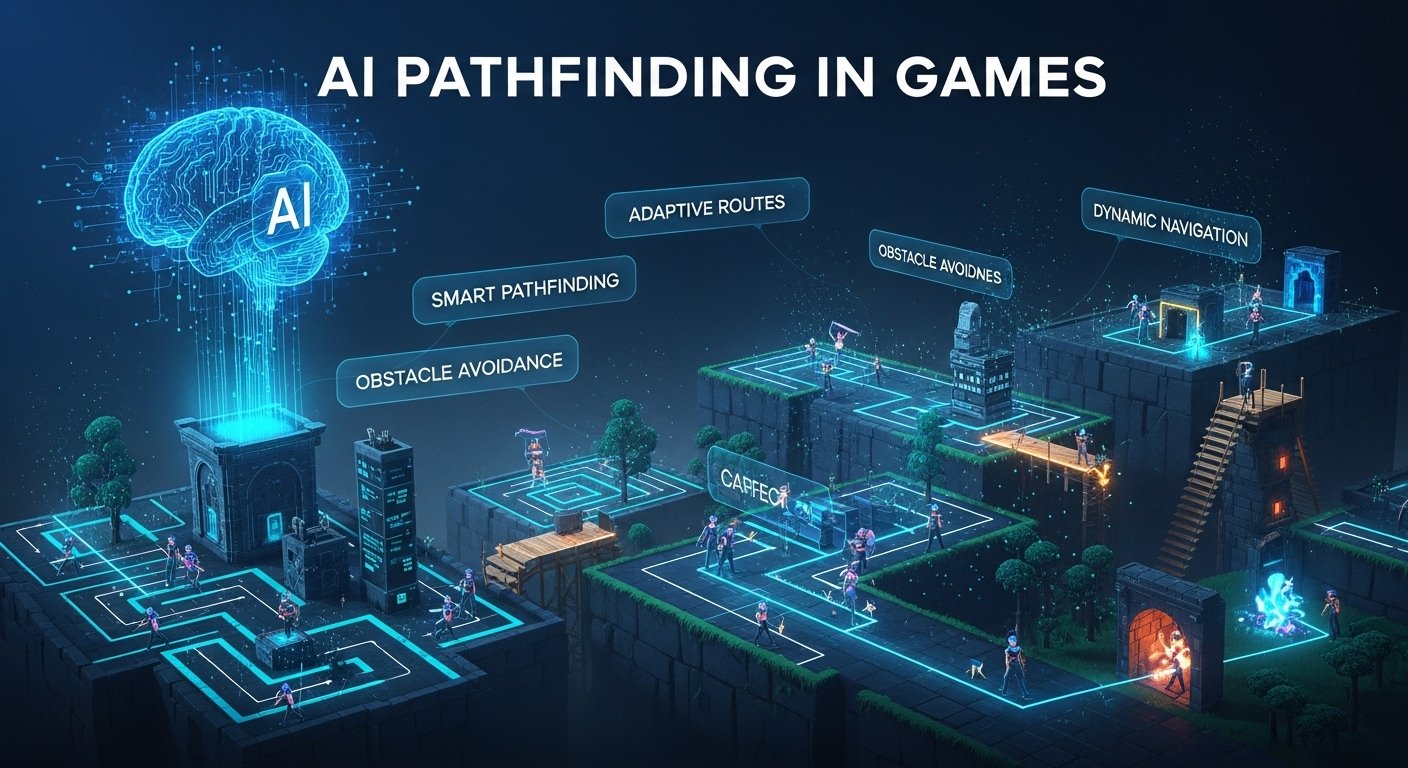
Years ago, I watched a friend stream a poorly optimized indie game where enemy soldiers kept walking into walls. Just endlessly bumping against corners, unable to figure out the obvious path around. The chat filled with laughter, but as someone who understood game development, I felt sympathy. Pathfinding looks easy until you try implementing it yourself.
That experience stuck with me because pathfinding represents one of gaming’s most underappreciated technical achievements. When it works, nobody notices. When it fails, everything breaks. Those characters navigating complex environments without thought? Behind them runs sophisticated mathematics that took decades to perfect.
What Pathfinding Actually Solves
At its core, pathfinding answers a deceptively simple question: how does a character get from point A to point B? Humans solve this intuitively. We glance at a room and immediately know how to cross it. Computers lack spatial intuition entirely. They need explicit instructions for every possible navigation scenario.
The challenge multiplies in complex environments. A character might need to navigate around dynamic obstacles, climb stairs, jump gaps, squeeze through doorways, or choose between multiple valid routes. Real-time games demand these calculations happen instantly while dozens of characters move simultaneously.
Early games avoided the problem entirely. Enemies in Pac-Man followed simple chase logic along predetermined corridors. Space Invaders aliens moved in fixed patterns. But as games grew more sophisticated, static movement became unacceptable. Players expected characters to navigate believably.
The Algorithms That Made It Possible
Edsger Dijkstra published his famous shortest-path algorithm in 1959, decades before video games existed. The algorithm systematically explores all possible paths from a starting point, tracking the shortest distance to each location until reaching the destination. It guarantees finding the optimal route but checks every possibility along the way.
Dijkstra’s approach works but proves computationally expensive for large environments. Checking every possible path wastes resources when you already know roughly where your destination lies.
A* (pronounced “A-star”) solved this elegantly in 1968. Peter Hart, Nils Nilsson, and Bertram Raphael added a crucial innovation: heuristic estimation. A* doesn’t just track how far it’s traveled it estimates remaining distance to the goal and prioritizes paths that seem promising. This focus dramatically reduces unnecessary exploration.
Imagine searching for a restaurant downtown. Dijkstra’s algorithm would check every street in the city equally. A* would head generally toward downtown, only exploring side streets when the main route proves blocked. Same destination, vastly different efficiency.
A* became the gaming industry standard and remains foundational today. Its elegance lies in balancing thorough searching with practical efficiency. Tweak the heuristic, and you can trade perfect paths for faster calculations a tradeoff many real-time games happily accept.
From Grids to Navigation Meshes
Early implementations represented game worlds as grids. Each tile was either passable or blocked. Characters moved between adjacent tiles, and A* calculated routes through this simplified representation. Many classic games still use grid-based pathfinding effectively.
Modern 3D environments demanded something better. Complex terrain couldn’t be reduced to simple tiles. Enter navigation meshes, commonly called navmeshes.
Navmeshes represent walkable surfaces as networks of connected polygons. Rather than tracking every grid square, the system stores larger traversable areas and their connections. Characters path between polygon centers, then smooth their movement within each polygon.
This approach handles complex geometry elegantly. Stairs, ramps, uneven terrain, and multilevel structures all become navigable through connected polygon networks. The computational savings are substantial a city block that might require millions of grid tiles reduces to hundreds of navigation polygons.
Building navmeshes traditionally required manual work from level designers. Modern engines like Unity and Unreal automate much of this process, analyzing geometry and generating navigation data automatically. The technology democratized sophisticated pathfinding for smaller development teams.
Watching Pathfinding in Action
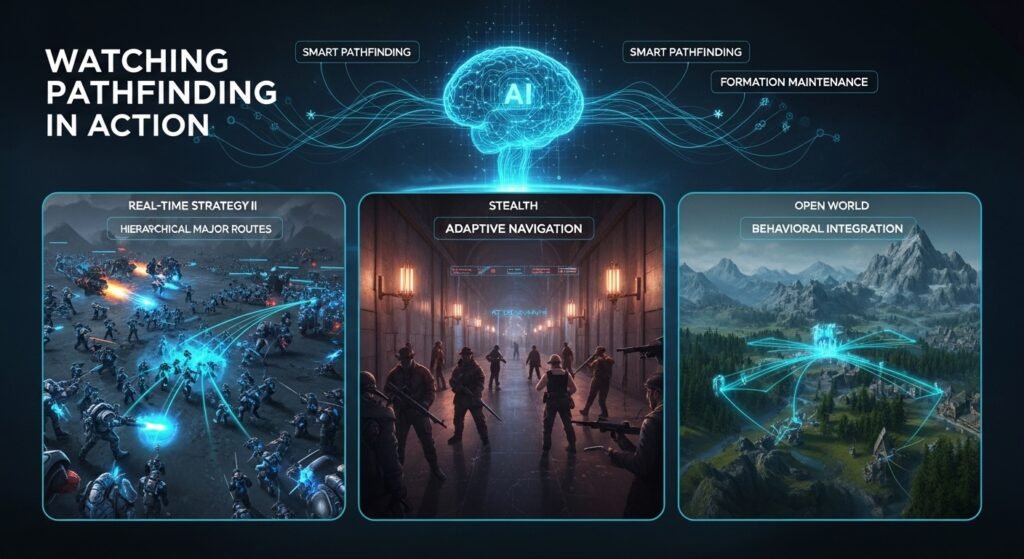
Different games showcase pathfinding strengths depending on their needs. Real-time strategy games stress these systems hardest, often coordinating hundreds of units simultaneously.
StarCraft II’s pathfinding handles massive armies navigating crowded battlefields. Units flow around obstacles, avoid collisions with allies, and find routes through chaotic combat. The system prioritizes group cohesion, keeping formations together when possible while still allowing individual units to navigate tight spaces.
The original StarCraft struggled notoriously with pathfinding. Units would take bizarre detours or get stuck entirely. The sequel’s improved navigation became a genuine competitive advantage, demonstrating how fundamental good pathfinding is to gameplay quality.
Stealth games present different challenges. Guards in Hitman must patrol believably, investigate disturbances, and search for players logically. Their pathfinding connects to perception and behavior systems, creating characters that navigate purposefully rather than randomly.
Open-world games like Skyrim face scale challenges. Characters must navigate entire continents with varying terrain types. The solution typically involves hierarchical pathfinding calculating rough routes between major areas, then refining paths locally. Long-distance travel might use road networks while local movement uses detailed navmeshes.
When Pathfinding Fails
Even sophisticated systems produce obvious failures. Characters walk into walls, take absurd detours, or freeze entirely when confronted with unusual geometry. Understanding why helps appreciate how difficult this problem remains.
Dynamic environments create most issues. Pathfinding calculates routes assuming stable terrain. When obstacles move or appear unexpectedly, cached routes become invalid. Recalculating constantly is expensive. Games must balance responsiveness against performance.
Crowd behavior compounds difficulties. Individual pathfinding works fine until thirty characters try navigating the same doorway simultaneously. Collision avoidance must layer on top of pathfinding, and the interactions between systems can produce strange emergent behaviors.
Edge cases plague developers endlessly. That one corner where geometry doesn’t quite connect properly. The narrow passage where characters shouldn’t fit but the navmesh says they can. The dynamic object that blocks paths in ways the system didn’t anticipate. Testing catches many problems, but complex games guarantee some will ship.
The Current State of the Art
Modern pathfinding incorporates techniques beyond pure path calculation. Steering behaviors handle the moment to moment movement within calculated paths. Flocking algorithms coordinate groups naturally. Influence maps help characters choose strategically advantageous routes rather than just shortest distances.
Machine learning applications are emerging, though traditional algorithms remain dominant for most games. Neural networks might eventually handle context-aware navigation that adapts to player behavior or learns from complex environmental patterns. Current implementations focus more on enhancing existing systems than replacing proven algorithms.
Cloud computing offers intriguing possibilities for massively multiplayer scenarios where server-side calculation could handle navigation for thousands of characters simultaneously. We’re seeing early experiments in this direction.
What hasn’t changed is the fundamental requirement: characters must navigate believably without consuming resources needed for everything else games do. That balance continues driving innovation in an often-invisible but absolutely essential technology.
Frequently Asked Questions
What is AI pathfinding in games?
AI pathfinding is the technology enabling game characters to calculate routes through environments, navigating around obstacles and terrain to reach destinations believably.
What algorithm do most games use for pathfinding?
A* (A-star) remains the industry standard due to its efficiency and flexibility, though games often combine it with other techniques for specific needs.
What is a navigation mesh?
A navigation mesh represents walkable game surfaces as connected polygons, allowing efficient pathfinding in complex 3D environments without grid-based limitations.
Why do characters sometimes walk into walls?
Pathfinding failures typically occur when dynamic obstacles invalidate calculated routes, geometry creates edge cases, or collision avoidance systems conflict with navigation.
How do games handle pathfinding for many characters?
Games use optimization techniques including hierarchical pathfinding, path caching, staggered calculations across frames, and simplified navigation for distant characters.
Is pathfinding the same as character AI?
No. Pathfinding handles navigation specifically. Character AI encompasses broader decision-making about what to do and where to go, with pathfinding determining how to get there.