
I spent three months hand crafting a single dungeon once. Every corridor placement, every enemy spawn, every secret alcove meticulously positioned through endless playtesting and revision. The result was solid. Players enjoyed it. But watching my work consume months of development time while knowing we needed dozens more levels? That experience fundamentally shaped how I think about AI-assisted level design.
The games industry faces an impossible equation. Players demand more content, larger worlds, and greater variety. Development timelines and budgets remain finite. Something has to give and increasingly, artificial intelligence is providing answers that seemed impossible just a few years ago.
Understanding What AI Level Design Actually Means
When people hear “AI-generated levels,” they often imagine computers randomly scattering platforms and enemies without human oversight. That misunderstanding misses what’s actually happening in modern game development.
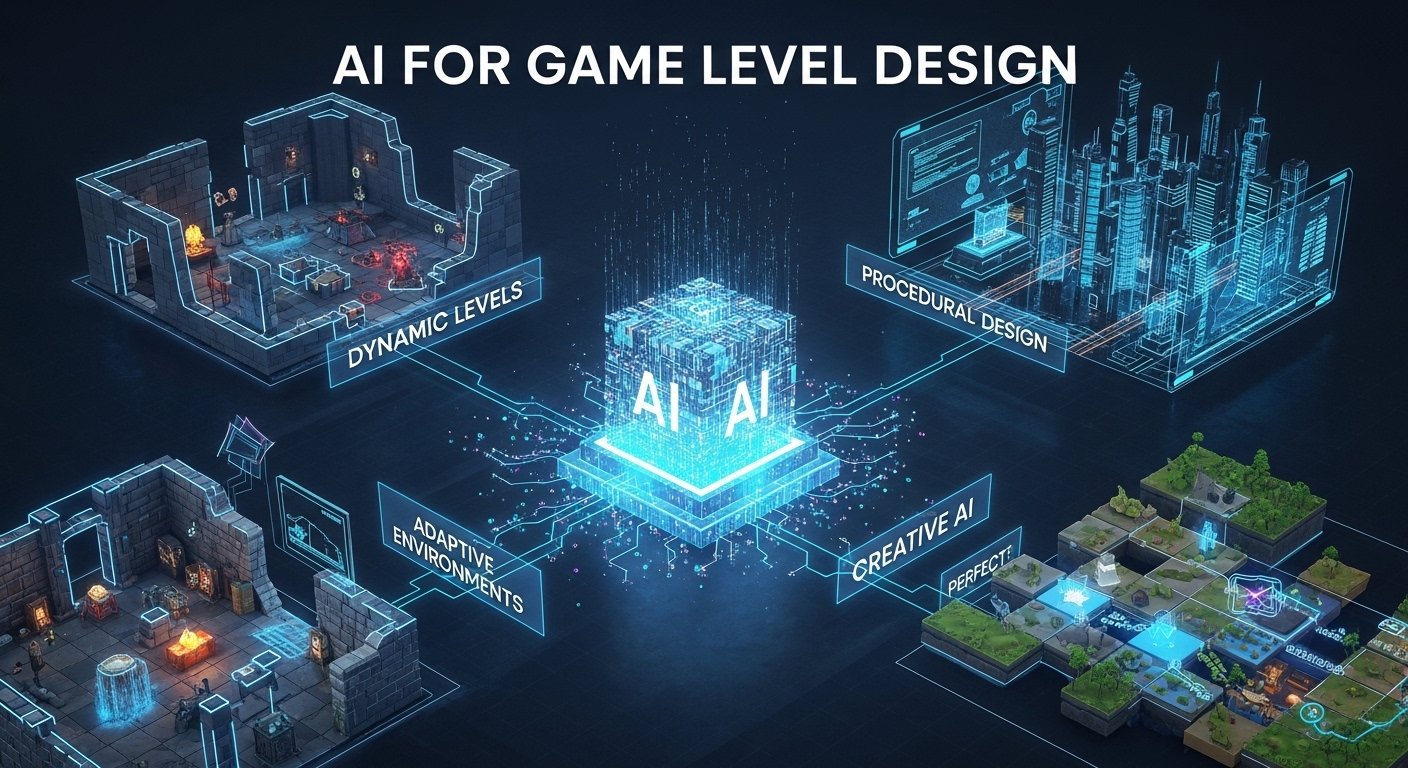
AI-assisted level design exists on a spectrum. At one end, you have fully procedural generation where algorithms create entire environments from scratch. At the other, AI serves as a collaborative tool that suggests layouts, identifies problems, and accelerates human designers’ workflows.
Most practical applications fall somewhere between these extremes. Developers establish parameters, rules, and aesthetic guidelines. AI systems then generate possibilities within those constraints, producing candidates for human evaluation and refinement.
Think of it less like replacing architects and more like giving them incredibly capable assistants who never sleep and can produce hundreds of sketches overnight.
The Technical Approaches That Actually Work
Several distinct methodologies power modern AI level design, each suited to different applications.
Procedural content generation uses algorithms following defined rules to create spaces. Roguelike games pioneered this approach titles like Spelunky and Dead Cells generate fresh layouts every playthrough using systems that ensure playability while maximizing variety. The rooms connect logically. Critical paths remain traversable. Difficulty progresses appropriately.
Search-based generation employs AI that tests countless configurations against specific criteria. Want levels where players encounter exactly three combat encounters before reaching a checkpoint? The system generates options, evaluates each against your requirements, and surfaces candidates meeting your specifications.
Machine learning approaches train models on existing level data to produce new content matching established patterns. Feed a neural network hundreds of successful platformer levels, and it learns spatial relationships, challenge curves, and design conventions that humans might never explicitly articulate.
Constraint-based systems work backward from requirements. Specify that players must acquire a key before reaching a locked door, that jumping sections should precede combat arenas, and that difficulty should escalate gradually the AI constructs spaces satisfying all conditions simultaneously.
Real Games Using These Techniques
The theory sounds impressive, but practical implementation matters more. Fortunately, numerous shipped games demonstrate what’s actually achievable.
No Man’s Sky generated eighteen quintillion planets using procedural systems governing terrain, flora, fauna, and atmospheric conditions. Each world follows ecological rules while maintaining uniqueness. Critics debated whether quantity replaced quality, but the technical achievement remains remarkable.
Diablo series dungeons have relied on procedural generation since 1996. Modern entries combine hand crafted setpieces with algorithmically-generated connective spaces, balancing authored moments against replayable variety.
Minecraft’s infinite worlds emerge from procedural terrain generation that somehow produces believable geography mountains transition into valleys, biomes shift logically, cave systems snake through underground spaces. None of it was hand-designed, yet it feels intentional.
Spelunky remains the masterclass in procedural platforming. Designer Derek Yu created component pieces and connection rules that produce genuinely challenging, fair levels every single run. The system never generates impossible situations because the rules prevent them.
What Developers Actually Gain
The benefits extend beyond simply producing more content faster.
Playtesting coverage improves dramatically when AI can generate thousands of layout variations overnight. Designers discover edge cases, balance issues, and unintended solutions that would take months to find through traditional testing. One studio I consulted with caught a game-breaking exploit using procedural stress-testing that human testers had missed across hundreds of hours.
Design exploration accelerates when algorithms produce options for human evaluation. Rather than sketching three room layouts and choosing the best, designers review fifty AI generated candidates, hybridize promising elements, and iterate from stronger starting points.
Personalization becomes feasible at scale. AI can theoretically tailor difficulty, pacing, and content variety to individual player preferences something impossible when every level requires months of manual construction.
Indie developers gain capabilities previously reserved for large studios. A solo developer can now ship games with variety that would have required teams of level designers using traditional workflows.
The Limitations Nobody Should Ignore
Honest assessment requires acknowledging where AI level design still struggles.
Authored experiences suffer under procedural approaches. The carefully crafted story moments, the environmental storytelling, the precise pacing of tension and release these emerge from intentional human design that algorithms cannot replicate. Dark Souls’ interconnected world works because designers hand-placed every shortcut and vista. No algorithm could produce that.
Quality consistency remains challenging. Procedural systems occasionally generate duds levels that technically function but lack flow, personality, or interesting decision points. Human curation often remains necessary.
Player pattern exploitation occurs when observant players decode generation rules. Once you understand how the algorithm thinks, procedurally generated challenges become predictable despite surface-level variety.
Creative distinctiveness gets sacrificed when AI learns from existing designs. The most innovative levels often break conventions that AI systems would avoid. Purely AI generated content risks feeling derivative, competent but never surprising.
Finding the Balance That Works
The most successful implementations treat AI as a collaborator rather than replacement.
Hades demonstrates this beautifully. Each room follows templates with procedural variation enemy compositions shift, reward types change, room shapes vary but designer intent drives the experience. The procedural elements create freshness without sacrificing crafted quality.
This hybrid approach lets humans focus on what they do best: establishing vision, creating memorable moments, and making creative decisions that define a game’s identity. AI handles iteration, variation, and the grunt work of populating vast spaces.
The level designers I know aren’t worried about obsolescence. They’re excited about leverage. Instead of spending months on repetitive tasks, they concentrate on the genuinely creative challenges that attracted them to game development in the first place.
Looking Ahead
Emerging techniques promise even deeper collaboration between human creativity and algorithmic capability. Systems that learn studio-specific styles, tools that identify design problems before playtesting, generators that understand narrative context these advancements suggest a future where AI amplifies human creativity rather than attempting to replace it.
The dungeon that took me three months? With current tools, I could probably achieve equivalent quality in three weeks while exploring twice as many layout alternatives. That’s not replacement. That’s empowerment.
And honestly? The games get better because of it.
Frequently Asked Questions
What is AI level design?
It encompasses various techniques where algorithms assist or automate the creation of game environments, from fully procedural generation to AI tools that support human designers.
Which games use AI-generated levels?
Notable examples include No Man’s Sky, Minecraft, Spelunky, Dead Cells, and the Diablo series each using different approaches suited to their genre.
Can AI replace human level designers?
Not for authored experiences requiring intentional creative vision. AI excels at variation and iteration but struggles with the distinctive touches that make levels memorable.
What are the main benefits for developers?
Faster content production, expanded playtesting coverage, design exploration assistance, and enabling smaller teams to create more content.
What are the biggest limitations?
Inconsistent quality, difficulty replicating authored experiences, player pattern exploitation, and tendency toward derivative rather than innovative designs.
How do hybrid approaches work?
Humans establish rules, templates, and creative direction while AI generates variations within those constraints—combining intentionality with scale.