
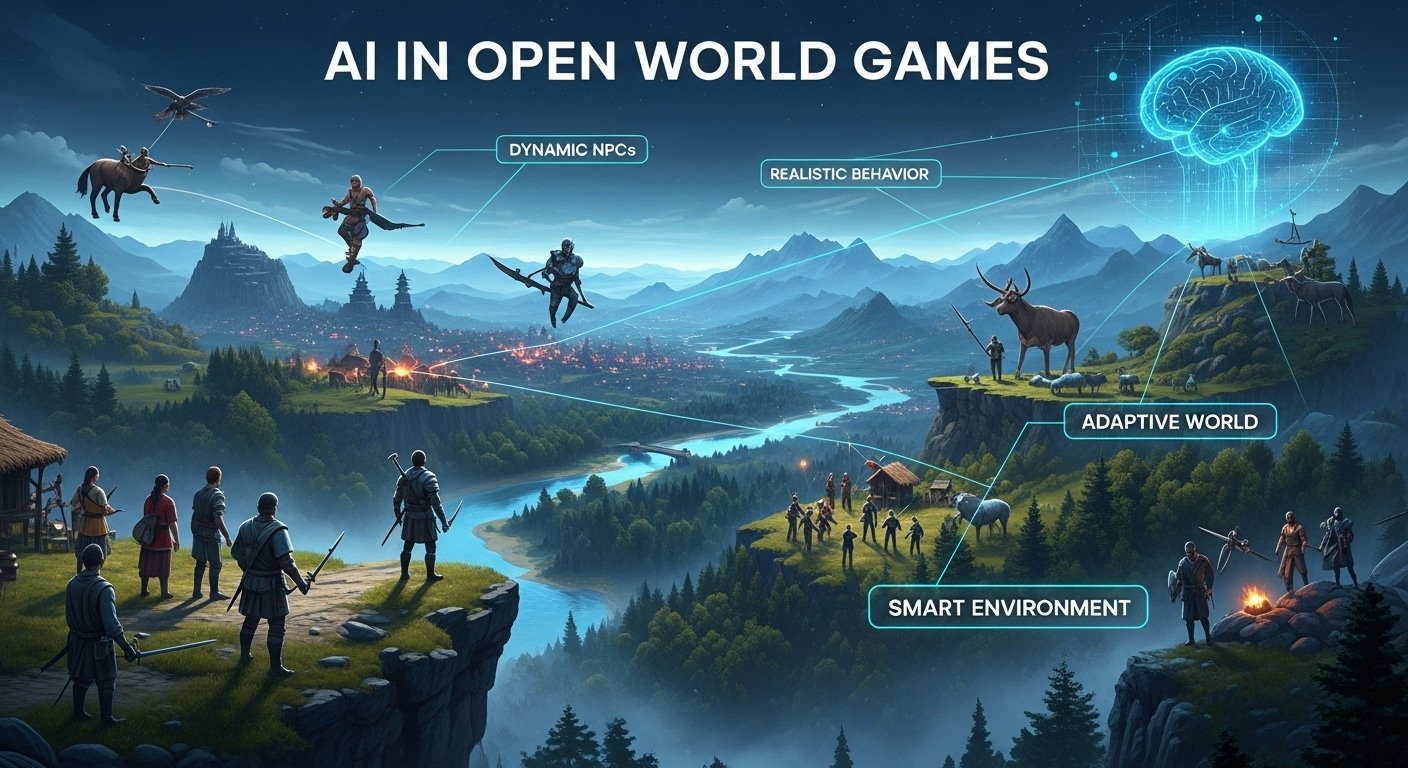
There’s a moment in Red Dead Redemption 2 that stuck with me for years. I was riding through the Heartlands at dusk when I spotted a stranger’s campfire in the distance. Curious, I approached. The man looked up, nervous at first, then relaxed when I holstered my weapon. He offered me a seat, shared some canned beans, and told me about his failed marriage back in Saint Denis.
Nothing about that interaction was scripted for me specifically. The game’s AI systems orchestrated everything his presence, his mood, his willingness to share. That’s the magic of modern open world game design, and it’s something I’ve been fascinated by since my first hours exploring Morrowind’s alien landscapes two decades ago.
What Makes Open World AI Different
Traditional linear games can carefully choreograph every enemy encounter and NPC interaction. Open world games don’t have that luxury. When players can go anywhere and do anything, developers need AI systems that respond dynamically to unpredictable situations.
This creates unique challenges. An NPC in a corridor shooter only needs to take cover, aim, and shoot. An NPC in an open world game might need to wake up, eat breakfast, walk to work, react to weather changes, flee from danger, remember past interactions with the player, and return home at night—all while potentially dealing with a player who decides to steal their horse.
The complexity scales exponentially. And honestly, getting it right is incredibly difficult.
The Evolution I’ve Witnessed
Playing open world games across different eras reveals just how far AI has come. Early titles like Oblivion had NPCs with basic daily routines that felt revolutionary at the time but seem almost comical now. Guards would chase you to the ends of the earth for stealing a sweet roll. Shopkeepers would stand motionless behind counters for eternity.
Compare that to something like Cyberpunk 2077’s Night City in its current patched state. Pedestrians react contextually to gunfire, weather, and time of day. Gang members exhibit territorial behavior. Fixers remember your reputation. The whole city feels like it’s operating with or without your involvement.
The Witcher 3 deserves special mention here too. CD Projekt Red created villages where peasants actually worked fields, attended festivals, and sought shelter during storms. Small details, maybe, but they accumulated into something that felt genuinely alive.
How Modern Systems Actually Work
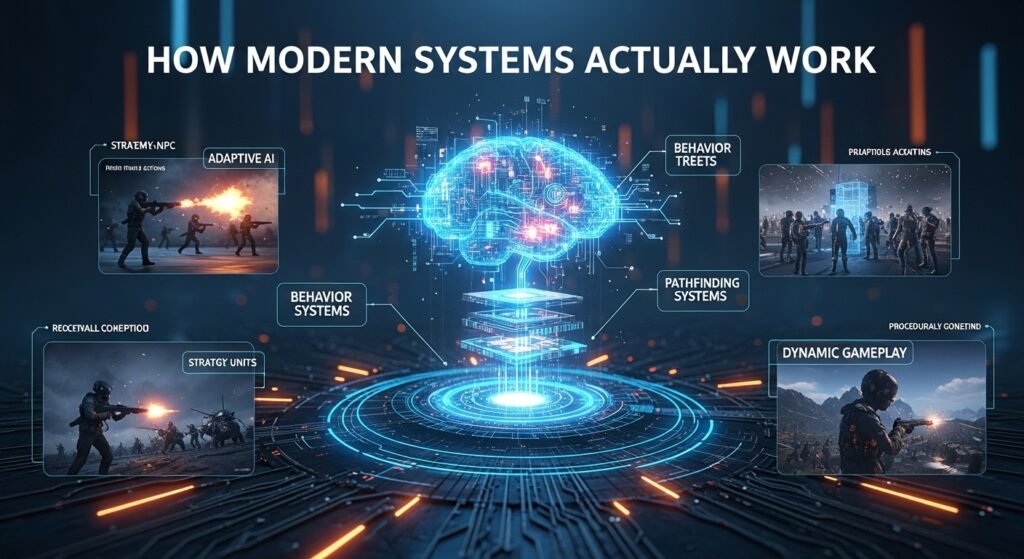
Most open world AI operates on layered behavioral systems. At the base level, you have simple state machines—NPCs switching between states like “idle,” “working,” “fleeing,” or “attacking” based on triggers.
Above that, many games implement goal-oriented action planning. NPCs have desires and needs, and the AI calculates the best sequence of actions to fulfill them. A hungry NPC might decide to find food, which means traveling to a market, which means navigating through streets, which might mean interacting with other NPCs along the way.
Perception systems add another layer. Characters only react to what they can plausibly see, hear, or otherwise detect. This creates opportunities for stealth gameplay and prevents the omniscient enemy problem that plagued older titles.
What impresses me most about recent implementations is emergent behavior—unscripted events that arise from multiple AI systems interacting. In Elden Ring, I’ve seen wildlife flee from approaching enemies, drawing those enemies into conflict with other hostile creatures, creating chaos that I could exploit. Nobody programmed that specific scenario. The AI systems just… figured it out.
Standout Examples Worth Studying
Red Dead Redemption 2 remains the benchmark for NPC believability. Rockstar’s attention to detail borders on obsessive. Gang members at camp have individual relationships, memories, and moods. Wildlife exhibits realistic ecosystem behavior. Even random strangers remember if you helped or ignored them previously.
The Elder Scrolls V: Skyrim, despite its age, pioneered the Radiant AI system that still influences design philosophy today. NPCs with needs, schedules, and relationships created a framework others have built upon.
Ghost of Tsushima took a different approach, using environmental AI to guide players through wind direction and animal behavior rather than traditional waypoints. Subtle, elegant, and deeply immersive.
Zelda: Tears of the Kingdom pushed emergent gameplay further than almost anything before it. The physics-based AI interactions create puzzle solutions that developers never explicitly designed. Players discovered techniques months after launch that surprised even Nintendo’s own teams.
The Persistent Challenges
Let’s be honest about limitations. Even the best open world AI falls apart under scrutiny. NPCs still walk into walls sometimes. Enemies occasionally lose track of players in ridiculous situations. Companions block doorways at the worst possible moments.
Resource constraints force compromises. Running sophisticated AI for thousands of simultaneous NPCs would melt most gaming hardware. Developers use clever tricks—simplifying behavior for distant characters, culling unnecessary simulations, streaming AI calculations—but the illusion breaks sometimes.
Player expectation management matters too. We’ve been trained by decades of gaming to expect certain AI behaviors. When a game tries something genuinely different, players sometimes perceive innovation as bugs. I remember early complaints about Cyberpunk 2077’s police system that, while flawed, was actually attempting something more realistic than GTA’s instant-spawn approach.
Where Things Are Heading
The next few years look genuinely exciting. Machine learning integration is enabling NPCs that adapt to individual player strategies. Procedural dialogue generation could eliminate the uncanny repetition that breaks immersion in long playthroughs.
More sophisticated simulation systems are emerging too. Dwarf Fortress, which finally received a graphical release, demonstrates what’s possible when AI simulation takes priority—entire histories emerge from system interactions.
Cloud computing might eventually offload complex AI calculations, allowing console and PC games to run simulations previously impossible. Whether that actually happens depends on infrastructure development and business model evolution.
My Honest Assessment
After spending thousands of hours in open worlds across dozens of titles, I remain genuinely optimistic about the direction AI is taking. The best modern games create moments of unscripted magic that linear experiences simply cannot match.
But I also appreciate the craftsmanship required. Building AI that feels natural while remaining computationally feasible is extraordinarily difficult work. The developers creating these systems deserve more recognition than they typically receive.
The goal isn’t perfect simulation—it’s believable simulation. And we’re getting closer with every major release.
Frequently Asked Questions
What is AI used for in open world games?
AI controls NPC behavior, enemy tactics, wildlife ecosystems, dynamic events, companion actions, and world simulation to create believable living environments.
Which open world game has the best AI?
Red Dead Redemption 2 is widely considered the benchmark for NPC believability and emergent behavior, though preferences vary by player priorities.
Why do open world game NPCs sometimes behave strangely?
Hardware limitations force compromises in AI complexity. Developers balance simulation depth against performance requirements, occasionally causing noticeable glitches.
How do enemies know where players are in open world games?
Modern games use perception systems simulating sight, hearing, and awareness. Enemies only detect players through plausible sensory information rather than omniscient knowledge.
Will open world AI continue improving?
Yes. Machine learning, cloud computing, and increasingly powerful hardware will enable more sophisticated simulations and believable NPC behavior in coming years.
Do open world games use procedural generation with AI?
Many do. AI systems often work alongside procedural generation to populate worlds, create dynamic quests, and simulate ecosystem interactions automatically.