
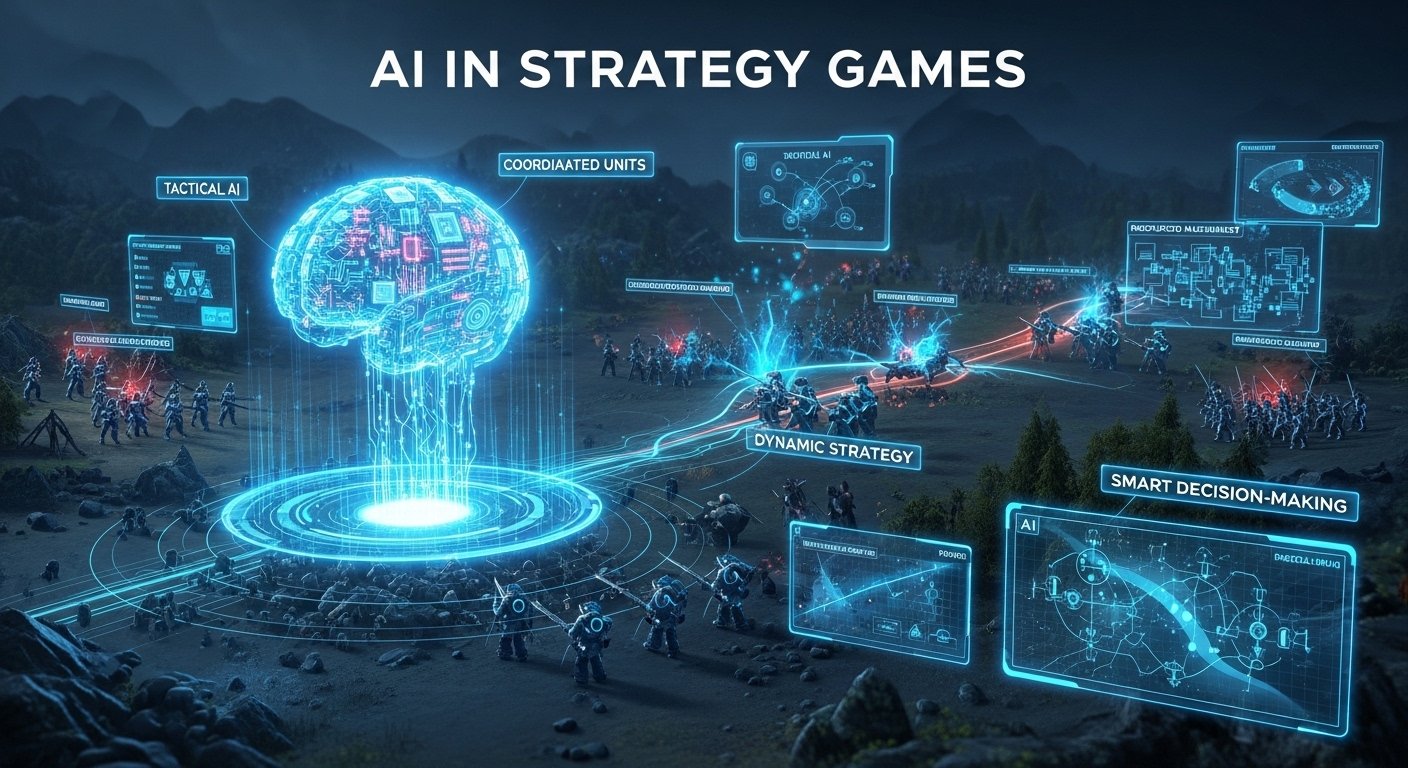
I still remember the first time a Civilization AI genuinely outsmarted me. It was Civ IV, probably around 2007. I’d been slowly building toward a cultural victory, feeling pretty confident about my position. Then Montezuma, who I’d dismissed as a nuisance, launched a perfectly timed invasion right as my military was at its weakest. He’d been watching. Waiting. Calculating.
That moment crystallized something for me about strategy game AI when it works, it creates experiences that feel genuinely competitive. When it doesn’t, the entire genre falls flat.
After spending more hours than I’d like to admit across countless strategy titles, from classic RTS games to sprawling grand strategy simulations, I’ve developed a deep appreciation for what developers face when creating these systems. It’s arguably the most demanding AI challenge in gaming.
Why Strategy AI Is Exceptionally Difficult
Most game genres require AI that reacts. Enemies in shooters need to take cover and aim. Racing opponents need to follow tracks. Strategy games demand something fundamentally more complex: AI that plans, adapts, manages resources, and thinks multiple moves ahead all while appearing fair to players.
Consider what a competent StarCraft II AI must juggle simultaneously. Base construction. Resource harvesting. Unit production. Scouting. Army composition. Map control. Timing attacks. Economic harassment. Tech progression. Counter-strategies based on opponent behavior. And it needs to handle all of this in real-time while facing a human who might employ any number of unpredictable strategies.
Turn-based games offer more processing time but introduce different challenges. A Civilization AI needs to think across hundreds of turns, maintaining coherent long-term strategies while responding to diplomatic shifts, territorial changes, technological developments, and the unpredictable actions of multiple opponents including the human player.
The sheer decision space in strategy games dwarfs other genres. Chess AI reached superhuman levels decades ago, but chess has clearly defined rules and victory conditions. Strategy games often have multiple victory paths, asymmetric factions, and emergent situations that developers never explicitly anticipated.
How Strategy Game AI Actually Works
Most strategy AI operates on hierarchical decision systems. At the highest level, a strategic layer determines overall goals expand territory, build economy, prepare for war, pursue diplomacy. This layer evaluates game state and sets priorities.
Below that, tactical layers handle implementation. If the strategy says “attack enemy base,” tactical AI manages which units go where, how they navigate the map, when they engage, and how they respond to resistance.
Utility AI systems have become increasingly popular. Rather than following rigid if-then rules, these systems assign scores to possible actions based on multiple weighted factors. An AI might evaluate attacking, defending, expanding, and teching simultaneously, choosing whatever option scores highest given current circumstances.
State machines still play crucial roles. An AI faction might transition between states like “early expansion,” “consolidation,” “aggressive posture,” or “desperate defense” based on trigger conditions. Each state activates different behavioral priorities.
What fascinates me is how different developers approach the same fundamental problems. Paradox Interactive’s grand strategy games use event-driven AI with heavy emphasis on personality traits aggressive rulers behave differently than cautious ones. Creative Assembly’s Total War series separates campaign AI from battle AI, with varying degrees of success across titles.
The Cheating AI Controversy
Let’s address the elephant in the room. Many strategy games, especially on higher difficulty levels, give AI opponents outright cheats. Extra resources. Visibility advantages. Reduced costs. Faster production.
I have mixed feelings about this approach. On one hand, it’s computationally cheaper than developing genuinely smarter AI, and it does increase challenge. On the other hand, it can feel deeply unfair when you discover the AI isn’t actually outplaying you it’s just operating under different rules.
Civilization’s difficulty scaling is perhaps the most notorious example. On Deity difficulty, AI civilizations start with extra settlers and warriors, receive substantial production and science bonuses, and enjoy reduced unhappiness. Skilled players can still win, but they’re overcoming artificial handicaps rather than competing against superior strategic thinking.
Some developers have pushed back against this trend. The AI War series explicitly designed AI that plays by the same rules as humans, focusing instead on interesting asymmetric scenarios. Offworld Trading Company’s AI demonstrates that economic strategy opponents can be genuinely competitive without cheating.
Standout Implementations Worth Mentioning
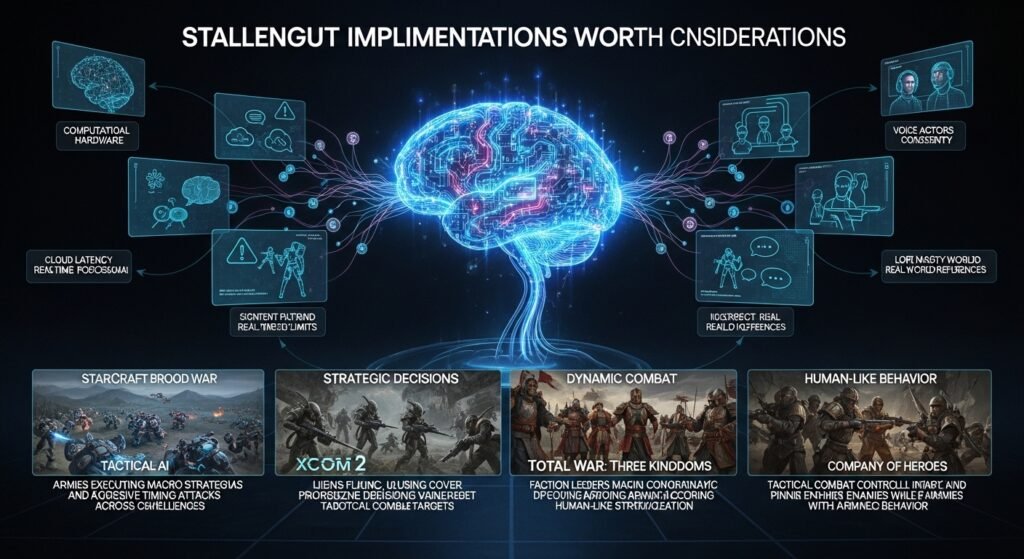
Certain games have achieved particularly impressive AI results. StarCraft: Brood War’s AI, while beatable by experts, provided genuine challenge through solid macro play and aggressive timing attacks. The game’s competitive scene eventually exposed its limitations, but for casual players, it delivered.
XCOM 2’s tactical AI deserves recognition for creating tense encounters through intelligent positioning and ability usage. Aliens coordinate flanking maneuvers, prioritize vulnerable targets, and use cover effectively. The strategic layer is weaker, but moment-to-moment combat feels genuinely adversarial.
Total War: Three Kingdoms improved campaign AI significantly over previous entries, with faction leaders making more coherent diplomatic decisions aligned with their characterizations. Liu Bei actually behaves like Liu Bei.
Company of Heroes earned praise for tactical combat AI that understood suppression, cover, and combined arms. Watching the AI flank with armor while pinning infantry with machine guns felt remarkably human.
The Persistent Limitations
Despite decades of refinement, strategy AI still struggles with several fundamental problems. Economy to military transition timing remains awkward in many RTS games AI either turtles too long or attacks with insufficient forces.
Adaptation to unusual strategies poses ongoing challenges. Experienced players develop “AI exploits” strategies that work against computer opponents but would fail against humans. The Total War series has long struggled with siege AI, for instance.
Diplomatic AI often feels mechanical and transactional. Even excellent games like Crusader Kings III sometimes produce nonsensical alliance decisions or baffling war declarations that break immersion.
Multiplayer-focused strategy games frequently treat AI as afterthought, resulting in opponents that serve only as practice dummies. Understandable from a development perspective, but disappointing for players who prefer solo experiences.
Looking Forward
Machine learning approaches are beginning to infiltrate strategy game development. AlphaStar’s StarCraft II demonstrations proved that learning based AI can achieve remarkable competence, though implementing such systems in commercial products presents practical challenges training costs, hardware requirements, and tuning for entertainment rather than pure competition.
Procedural personality systems might help AI opponents feel less predictable. Rather than fixed behavioral profiles, AI leaders could develop tendencies based on game history, creating unique adversaries each playthrough.
Whatever direction things take, the fundamental goal remains unchanged: creating opponents that challenge us, surprise us, and make victories feel earned.
That’s what Montezuma did to me all those years ago. And despite losing that game badly, I kept playing. That’s the mark of AI done right.
Frequently Asked Questions
What makes strategy game AI different from other genres?
Strategy AI must handle long-term planning, resource management, multi-unit control, and adaptation to unpredictable situations simultaneously, creating exponentially more complex decision requirements.
Do strategy games cheat on higher difficulties?
Many do. Higher difficulty settings often give AI opponents resource bonuses, production advantages, or other artificial handicaps rather than improved decision-making.
Which strategy game has the best AI?
Opinions vary, but XCOM 2’s tactical AI and StarCraft II’s competitive AI frequently receive praise. Different subgenres have different standouts.
Why do strategy AI opponents make obvious mistakes?
Computational limitations, testing constraints, and the impossibility of anticipating every player strategy mean even good AI has exploitable weaknesses.
Will machine learning improve strategy game AI?
Potentially yes. Demonstrations like AlphaStar show promise, but implementing learning-based AI in commercial products remains challenging and expensive.
Can AI ever truly match human strategy players?
In narrow domains with fixed rules, yes. In complex games with multiple viable strategies and asymmetric designs, AI still struggles against expert human players.