
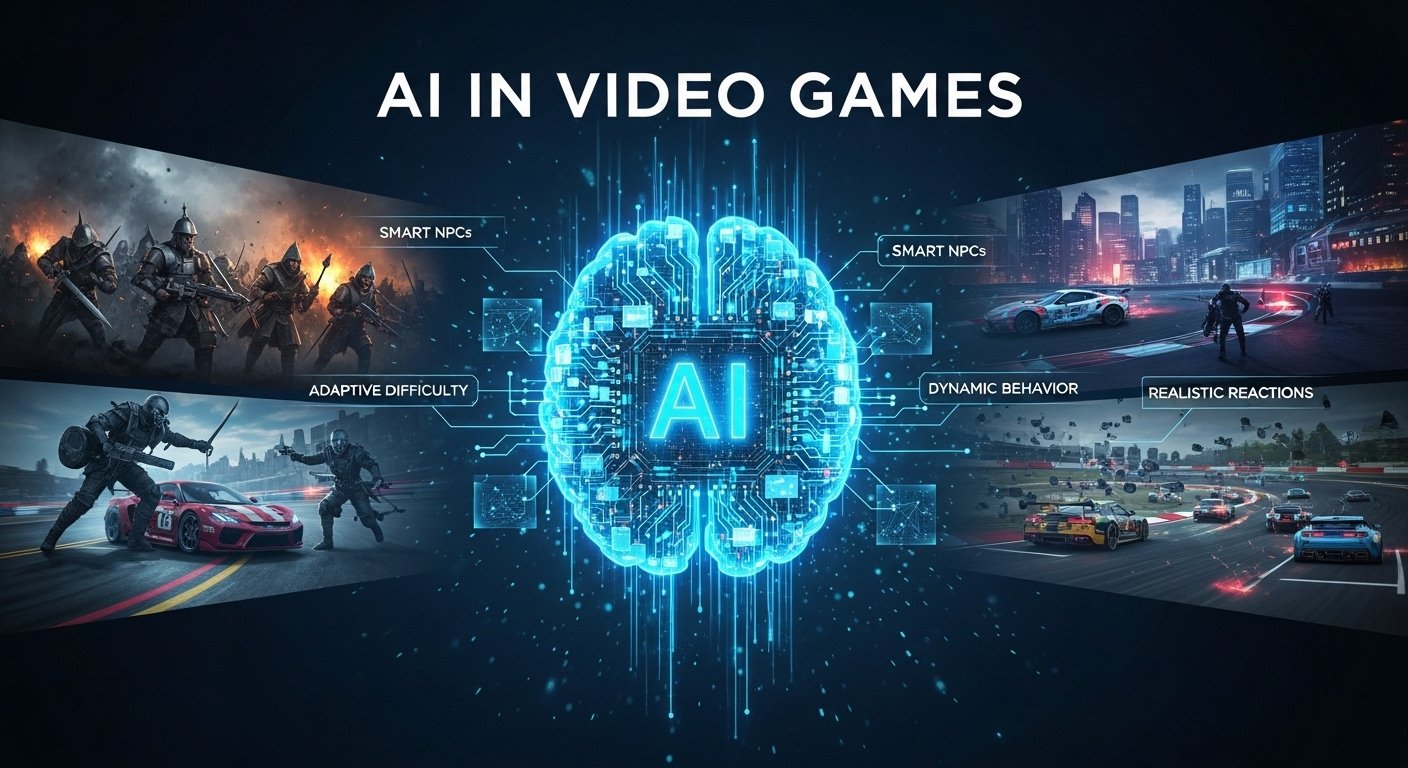
There’s a moment I remember vividly from playing The Last of Us Part II. An enemy called out my position to his squadmates, flanked around a corner I didn’t expect, and forced me to completely abandon my hiding spot. It felt real. That interaction stuck with me because it represented something video games have been chasing for decades genuine, responsive intelligence.
After spending years analyzing game design and watching the industry evolve, I’ve seen artificial intelligence transform from simple programmed responses into sophisticated systems that genuinely surprise players. Let’s dig into how AI actually works in video games and where it’s headed.
The Foundation: What Game AI Actually Does
Here’s something many players don’t realize game AI isn’t trying to outsmart you. That might sound counterintuitive, but hear me out. The goal isn’t creating unbeatable opponents. It’s crafting engaging, believable experiences that keep you playing.
Early games used basic scripts. Pac-Man’s ghosts followed predetermined patterns. Space Invaders moved in predictable formations. These weren’t intelligent systems; they were choreographed routines designed to create challenge through memorization.
Modern game AI operates on entirely different principles. Today’s systems use decision trees, finite state machines, behavior trees, and sometimes machine learning to create dynamic responses. The difference is night and day.
Behavior Trees and Decision Making
Most contemporary games rely on behavior trees hierarchical structures that determine how characters act based on conditions. Think of it like a flowchart running hundreds of times per second.
When you play Red Dead Redemption 2, those townsfolk aren’t following random paths. Each character evaluates their environment, considers their programmed personality traits, and makes choices accordingly. A shopkeeper opens his store at dawn. Drunks stumble toward the saloon at dusk. Wildlife responds to weather patterns and player proximity.
This layered approach creates what designers call “emergent behavior” moments that weren’t explicitly programmed but arise naturally from intersecting systems.
Enemy AI: The Art of Fair Challenge
Creating enemies that feel intelligent without being frustrating requires careful balance. I’ve played countless games where enemies either felt brain-dead or impossibly omniscient. Neither extreme works.
The Halo franchise pioneered something remarkable with its Covenant AI. Grunts panic when Elites fall. Jackals raise shields defensively. Hunters coordinate attacks. Bungie’s team spent enormous resources making each enemy type feel distinct and reactive.
Metal Gear Solid V took different approach. Enemies learn from your tactics. Headshot too many guards? They start wearing helmets. Attack at night repeatedly? Night vision goggles appear. This adaptive difficulty keeps gameplay fresh without artificial stat inflation.
F.E.A.R., released back in 2005, still impresses me with its squad-based enemy AI. Soldiers communicate positions, suppress your location, and execute genuine flanking maneuvers. Playing it today, those combat encounters hold up remarkably well.
Companion AI: The Harder Problem
Creating helpful, non-annoying companion AI might be gaming’s greatest challenge. We’ve all experienced terrible companion AI characters who block doorways, trigger alarms, or die repeatedly in scripted sequences.
Recent games have made tremendous progress here. Ellie in The Last of Us dynamically assists in combat, provides resources, and stays out of your way during stealth sections. She’s invisible to enemies not because of programming laziness, but because playtesting revealed that players hated failing due to companion mistakes.
God of War’s Atreus represents another triumph. He calls out enemy attacks, contributes meaningfully to combat, and enhances gameplay rather than hindering it. Achieving that balance required years of development and iteration.
Procedural Generation and Creative AI
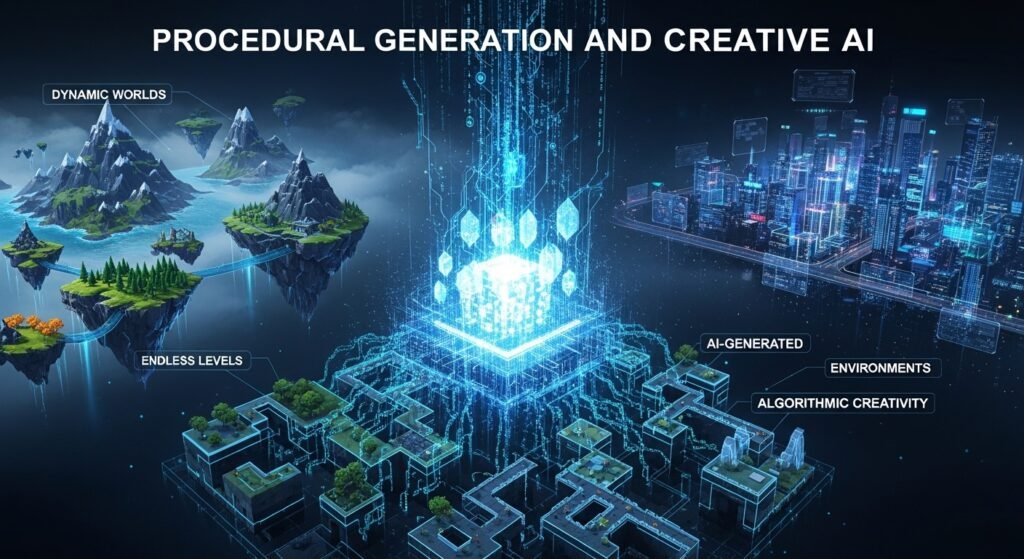
Beyond character behavior, AI powers procedural generation creating content algorithmically rather than manually designing every element.
Minecraft revolutionized this concept with terrain generation. No two worlds are identical, yet each feels cohesive and explorable. The system follows rules about biome placement, cave formation, and resource distribution while allowing infinite variation.
No Man’s Sky pushed further, generating entire planets, creatures, and ecosystems through complex algorithms. The results aren’t always perfect, but the sheer scope wouldn’t be possible through traditional design methods.
Hades uses AI-driven systems to balance its roguelike runs, adjusting encounter difficulty and reward distribution based on player performance. This invisible hand keeps the experience challenging without becoming punishing.
Current Industry Trends
Several developments are reshaping game AI right now.
Neural networks are beginning to appear in commercial games, though sparingly. Training costs remain high, and unpredictable results concern developers. However, smaller applications like natural language processing for character dialogue are gaining traction.
Cloud computing enables more sophisticated AI calculations. Streaming services can offload complex computations, allowing richer simulations than local hardware could manage.
Dynamic difficulty adjustment continues evolving. Rather than simple easy/medium/hard settings, games increasingly modify themselves in real-time based on player skill indicators.
Limitations Worth Acknowledging
Game AI still faces significant constraints. Processing power limits how complex behaviors can become while maintaining stable framerates. Memory restrictions force developers to prioritize certain systems over others.
Perhaps most importantly, AI can’t truly understand context. It simulates understanding through clever programming, but genuine comprehension remains beyond current technology. Those lifelike NPCs are still following rules, however sophisticated those rules become.
Looking Forward
The next decade promises exciting developments. More sophisticated behavior modeling, improved companion systems, and smarter procedural generation all seem inevitable. Whether true machine learning becomes standard in mainstream games remains uncertain the computing requirements and unpredictability still pose challenges.
What excites me most isn’t raw technical advancement but how designers use these tools creatively. The best game AI doesn’t announce itself. It simply makes experiences feel alive.
Frequently Asked Questions
Can game AI actually learn from players?
Some games implement machine learning systems that adapt to player behavior, but most use predetermined rule sets that create the illusion of learning through conditional programming.
Why do companions sometimes act stupidly in games?
Companion AI must balance helpfulness against player autonomy. Making companions too capable removes player agency, so developers intentionally limit their effectiveness.
What game has the most advanced enemy AI?
F.E.A.R., The Last of Us Part II, and Alien: Isolation frequently receive recognition for exceptional enemy AI that creates genuinely tense, unpredictable encounters.
Does better AI require more powerful hardware?
Complex AI calculations do demand processing power, but clever optimization allows impressive AI on modest hardware. Smart design matters more than raw specs.
Will AI eventually replace game designers?
AI tools assist designers but can’t replace human creativity. Games require emotional intelligence, cultural awareness, and artistic vision that algorithms cannot replicate.