
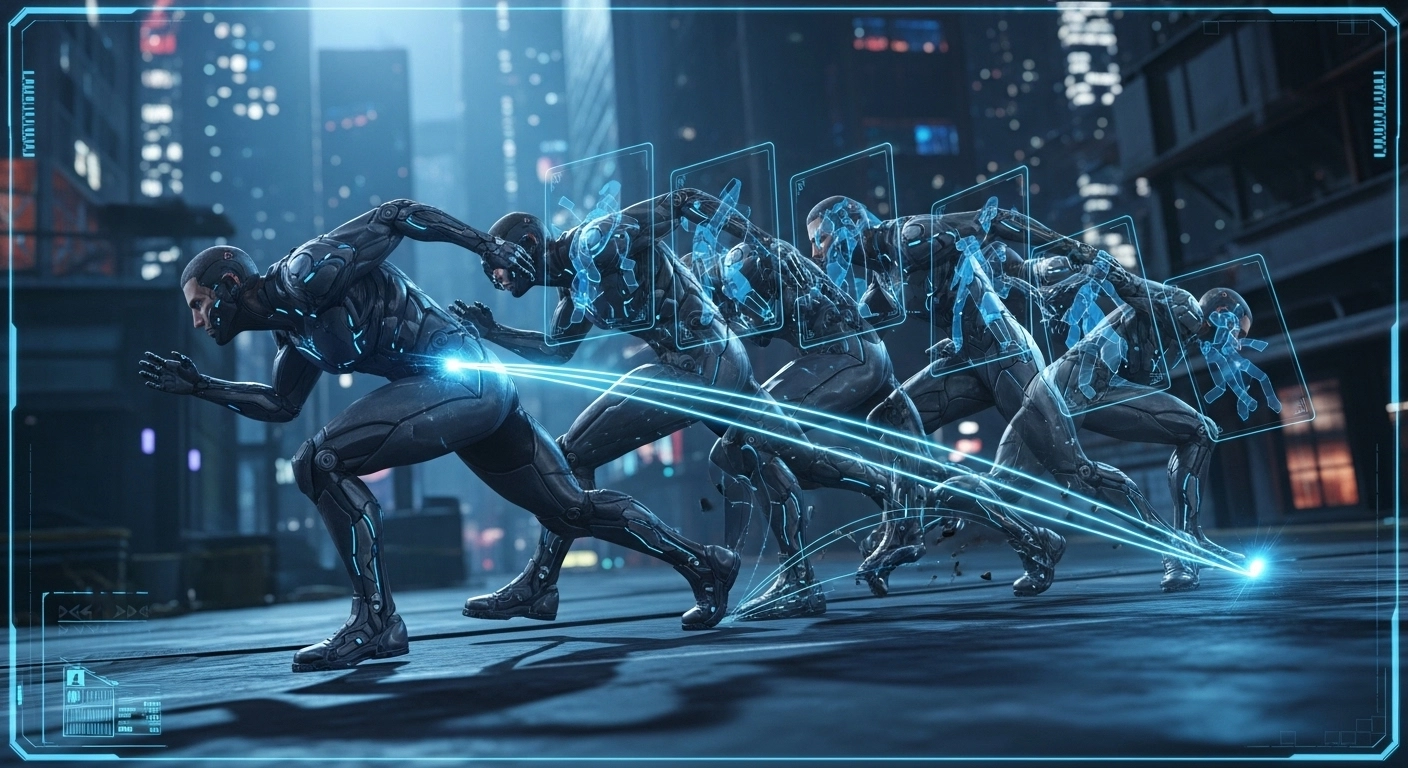
I still remember the exact moment motion matching clicked for me. Watching a behind the scenes presentation from Ubisoft’s animation team around 2016, seeing a character seamlessly transition from sprinting to a sudden direction change without any visible blend artifacts it felt like witnessing a paradigm shift. Traditional animation systems couldn’t achieve that fluidity, not without tremendous compromises.
Motion matching has quietly revolutionized how game characters move, yet most players experience its benefits without ever knowing the technology exists. That’s precisely the point. When animation works perfectly, it becomes invisible.
What Exactly Is Motion Matching?

At its core, motion matching is an animation technique that continuously searches through massive libraries of motion capture data to find the best possible movement for any given moment. Unlike traditional state machines that transition between predefined animation clips, motion matching treats the entire motion database as one seamless resource.
Think of it like this: traditional animation is like having a filing cabinet with labeled folders. Running goes in one folder, jumping in another, turning left in a third. The system opens folders based on player input and tries to blend smoothly between them.
Motion matching throws away the folders entirely. Instead, it asks a fundamentally different question every single frame: “Given where the character is, what they’re doing, and what the player wants next, which tiny slice of recorded motion best matches this exact situation?”
The system searches through thousands of potential matches dozens of times per second. It’s computationally demanding but produces results that look remarkably natural.
The Technical Foundation
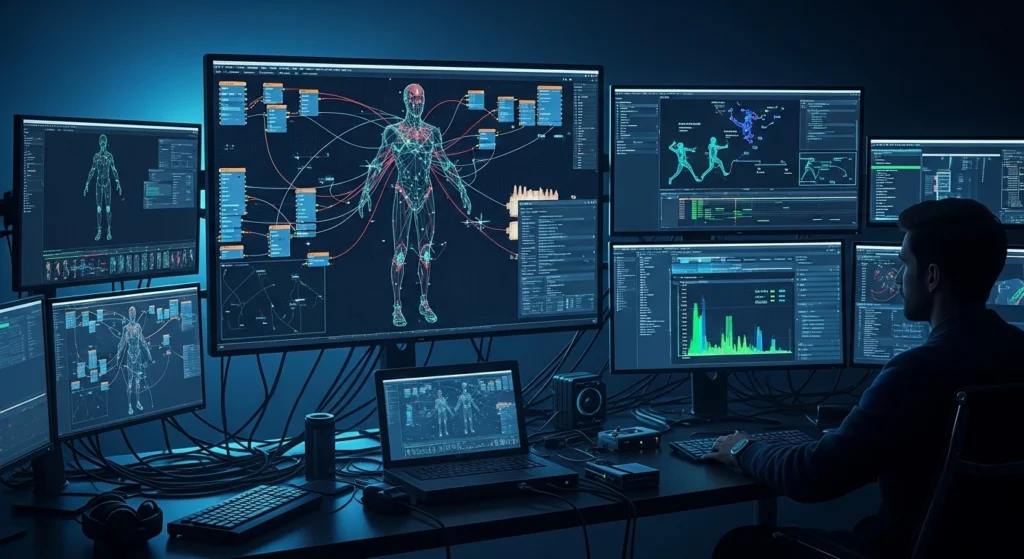
Simon Clavet and his colleagues at Ubisoft Montreal developed the foundational work that brought motion matching into mainstream game development. Their GDC 2016 presentation demonstrated the technique applied to For Honor’s melee combat, where responsive yet realistic animation was absolutely critical.
The algorithm examines several factors when selecting motion candidates. Current character pose matters enormously the system needs continuity from the previous frame. Velocity and trajectory influence selection too, ensuring movements maintain physical plausibility. Player input gets factored in as desired future state, guiding the search toward animations that will satisfy what the player wants to happen next.
What makes motion matching special is how it handles transitions. Traditional systems require animators to create explicit blend states between movements. Walk to run blends. Turn while running blends. Jump from standing versus jump from moving blends. The combinations multiply exponentially with character complexity.
Motion matching sidesteps this explosion by finding natural transition points within the captured data itself. If an actor performed thousands of movements during motion capture, natural transitions between those movements already exist in the recordings. The algorithm just needs to find them.
Games That Showcase the Technology
For Honor demonstrated motion matching in combat scenarios, where animation responsiveness directly impacts gameplay feel. Players needed attacks to feel immediate while still looking realistic a balance that traditional systems struggled to achieve.
Naughty Dog’s implementation in The Last of Us Part II pushed the technology further into environmental interaction. Characters would reach toward walls for stability, adjust footwork on uneven terrain, and exhibit countless contextual behaviors. The development team captured enormous amounts of motion data, then built systems that made characters feel genuinely present in physical spaces.
EA Sports has embraced motion matching for their sports titles. The FIFA series (now EA FC) uses related techniques to create more natural athlete movements. When a player receives a pass, the animation system considers their momentum, the ball’s trajectory, defensive pressure, and the player’s next likely action. The resulting motion feels organic rather than robotic.
Guerrilla Games implemented motion matching for Horizon Forbidden West, allowing Aloy to navigate varied terrain with unprecedented fluidity. Climbing, swimming, running through vegetation each movement type benefits from contextual animation selection.
The Capture Requirements
Here’s something that doesn’t get discussed enough: motion matching demands extraordinary amounts of captured data. Traditional animation libraries might include hundreds of clips. Motion matching systems often require hours of continuous performance capture.
Studios bring actors in for extended sessions, having them perform movements in countless variations. Walking at different speeds. Turning at various angles. Starting and stopping under different conditions. The more variation in the database, the better the system performs.
This creates significant production overhead. Smaller studios without access to motion capture facilities face substantial barriers to implementing motion matching. The technology has democratized somewhat through middleware solutions, but data requirements remain a limiting factor.
Limitations Worth Acknowledging
Motion matching isn’t without drawbacks. Database size presents ongoing challenges storing and streaming gigabytes of motion data requires careful memory management. Processing demands remain considerable, though hardware improvements have helped substantially.
There’s also an artistic consideration that gets overlooked. Motion matching prioritizes physical realism, which doesn’t always serve stylized games well. A character in a Nintendo title might benefit from exaggerated, unrealistic movements that convey personality. Motion matching’s strength naturalistic motion becomes a limitation when exaggeration serves the design better.
Responsiveness can suffer too. Finding the perfect natural transition sometimes means brief delays before characters begin responding to input. Competitive games where frame perfect reactions matter might sacrifice some realism for immediate responsiveness.
Where Motion Matching Is Heading
The technology continues evolving rapidly. Researchers are exploring learned motion matching, where neural networks compress motion databases into models that generate appropriate movements rather than searching through raw data. This could dramatically reduce memory requirements while maintaining quality.
Real time motion synthesis represents another frontier. Rather than capturing every possible movement, systems could learn movement principles and generate novel animations that were never explicitly recorded. Some current implementations already blend these approaches.
Integration with physics simulation is advancing too. Characters that not only animate realistically but respond dynamically to physical forces represent the next level of believability.
Final Perspective
Motion matching represents one of those technologies that fundamentally changes expectations. Once you’ve experienced characters that move with genuine fluidity, older animation systems feel obviously mechanical. There’s no going back.
For developers, motion matching offers powerful tools but demands significant investment in capture data and technical implementation. For players, it delivers immersion that works on subconscious levels—characters that simply feel right without requiring conscious analysis.
The best technology often disappears into experience. Motion matching, when implemented well, achieves exactly that invisibility.
Frequently Asked Questions
What is motion matching in simple terms?
Motion matching is an animation technique that continuously searches through recorded movement data to find the best motion for each moment, creating seamless character animation.
Which games use motion matching?
Notable examples include For Honor, The Last of Us Part II, Horizon Forbidden West, EA FC series, and various AAA titles released after 2018.
How is motion matching different from traditional animation?
Traditional animation uses state machines with explicit transitions between clips. Motion matching searches entire motion databases frame by frame for optimal movement selection.
Does motion matching require motion capture?
Typically yes. The technique relies on large libraries of captured human movement, though some implementations use handcrafted animation data.
Why don’t all games use motion matching?
It requires substantial motion capture data, significant processing power, and technical expertise. Stylized games may also prefer exaggerated animation over realism.
Can indie developers use motion matching?
Yes, through middleware solutions and more accessible tools, though data requirements still present challenges for smaller teams.